
From Gamer To GameDev: Part III
Detouring From the Halloween Tree Through The Mountains of Madness

From childhood's hour I have not been
As others were -- I have not seen
As others saw -- I could not bring
My passions from a common spring --
From the same source I have not taken
My sorrow -- I could not awaken
My heart to joy at the same tone --
And all I lov'd -- I lov'd alone --
Then -- in my childhood -- in the dawn
Of a most stormy life -- was drawn
From ev'ry depth of good and ill
The mystery which binds me still --Excerpt from “Alone” by Edgar Allen Poe
On more than one occasion, I found my mother dead on our living room floor — or at least that’s how it appeared to my grade school eyes. Her rosy complexion would be drained of all color. Her hands would be limp and cold to my touch, and her beautiful cornflower blue eyes vacant of life as they fixed on some point far, far beyond the mortal realm.
At that age I wasn’t yet equipped to understand the complex conditions that afflicted my mother, or the challenging medical history that made it nearly miraculous that she’d brought me into the world at all. She’d been declared stillborn at her birth, but spontaneously revived after a doctor left the farmhouse where he’d delivered her. He’d formally filed her death certificate in one county, but my grandparents would file a live birth certificate for her in another county, rendering my mother legally both dead and alive (a mixup that wouldn’t be discovered until she attempted to file for my father’s social security death benefit decades later.) When she was in grade school, a natural gas leak in a gasoline station where she was living with my grandparents would nearly kill the entire maternal side of my family in their sleep. Although everyone would survive thanks to an uncle waking the family up before it was too late, that event is believed to have contributed to my mother’s lifelong heart problems. As she matured into adulthood, she suffered from severe thyroid problems that would drop her like a rock in the flash of an eye. Every time I watched it happen, I’d wonder if this was it, if this time she wouldn’t be coming back from the dead.
If my mother’s seeming deaths and resurrections weren’t enough to unsettle my suggestible pre-adolescent mind, I also had to deal with the fact that occasionally, she suffered from delusions or even outright hallucinations. She’d develop the idea that she was being followed, or that unnamed people were watching our house. On more than one occasion, she woke me and my brother and my father to tell us all that there were unidentified someones in our backyard who had been calling her name. Today I can recognize that these were potentially symptoms of PTSD arising from things she’d experienced in childhood, or potentially even something as serious as latent schizophrenia. But back then, before I had fancy words and concepts to corral these disturbances into something manageable, I could only think of these episodes as supernatural in origin. Add this to the fact that my father’s side of the family frequently shared ghost stories about a farm they grew up on, and they swore these stories were all absolutely one hundred percent true. Although I was growing up in a perfectly ordinary suburban house, to outsiders my life might have seemed absolutely gothic.
Given these circumstances, I think almost anyone else would have tried to avoid contact with any kind of horror literature lest they be unpleasantly reminded of the peculiarity of their lives. I, on the other hand, found refuge in it. I rapaciously watched old Universal and Hammer horror movies, collected Famous Monsters of Filmland magazine, and threw myself into the annual celebration of Halloween as though it were my personal salvation. It was — and still is — my favorite night of the year. My love for that holiday would lead me to Ray Bradbury’s The Halloween Tree which would make me into a lifelong fan of his work. His deliciously creepy short stories like The Small Assassin, and The Ravine would blaze the trail for me to discover one of my favorite novels of all time, Something Wicked This Way Comes (which was adapted into the stellar Disney movie of the same name from 1983…hands down the best adaptation of any of his works to date.)
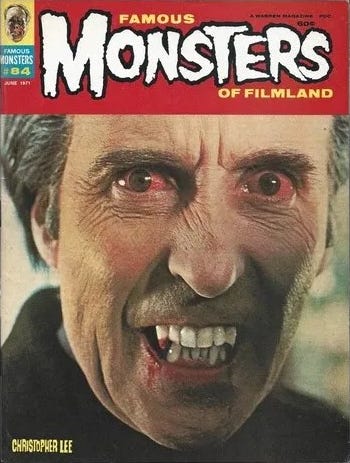
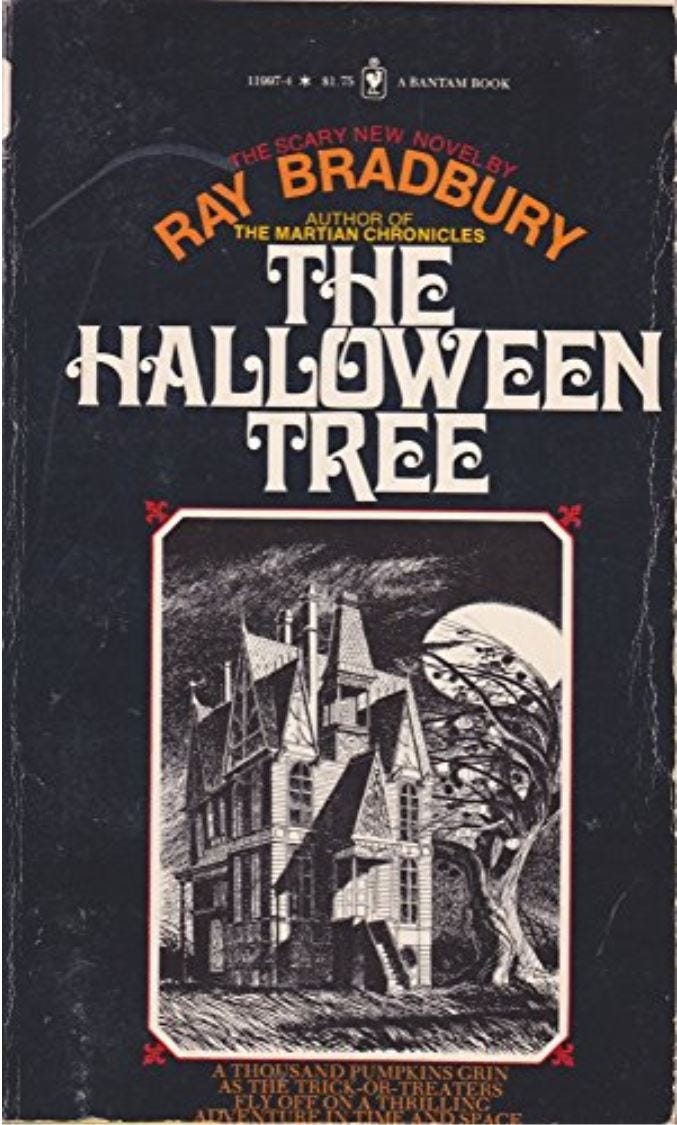
A LITTLE DARK READING - I had no lack of reading material to feed my love for monsters and horror as a kid. During the 70s, every convenience store magazine rack was packed with horror magazines and comics, with Famous Monsters of Filmland (above) being one of the best. You couldn’t beat having the king of the vampires, Christopher Lee, on the cover. I would discover Ray Bradbury’s recently published The Halloween Tree (above) on a bookshelf in one of my elementary school classrooms, and I’d read it a dozen times or more.
By the time I reached middle school, I was a die-hard horror fan, and some of the newfound Trekkie friends that I’d made at Central Junior High also shared my love of the works of Bradbury. I remember lots of conversations about The Martian Chronicles, but even as Bradbury had broadened the kinds of fiction I was reading (and almost impossibly raised the bar when it came to my expectations for quality prose), it also nudged me towards the darker and more serious works of Edgar Allen Poe.
I want you to consider Poe’s pre-occupations with premature burials and familial madness — as evinced in Ligea, The Premature Burial, The Cask of Amontillado, and Fall of the House of Usher for example — and how those narratives landed for someone like myself who had witnessed events that weren’t entirely dissimilar to the kinds of things in Poe’s works. I could all too easily imagine my mom being carted off and buried while she was in one of her catatonic waking death moments (yes, I know she wasn’t technically dead, but you couldn’t have proved that by me back in those days). And then there were those moments when she clearly was seeing and hearing things that I could not, and how could I not worry that someday I might end up with other family members looking at me as though I was totally crazy (okay, well they do, but not in a we’re-taking-you-to-the-looney-bin sort of way). Did I have a taint of madness in my blood? Was that my destiny? At this point I should also remind you that these questions had already been posed about me thanks to my elementary school teacher who thought I drew too many monsters in class, and this was unquestionably a sign of creeping mental illness. (Check out my previous blog entry in this series for more perspective on that.) With all of this taken together, it felt as though Poe was simply chronicling what was going on in my own life, albeit it in an elevated way.
By eighth grade, I was studying English with Mrs. Imelda Guthery, someone who would become one of my favorite and most influential teachers. Even though I had never spoken to her or anyone else about my anxieties or sense of alienation from other people, I sensed early on that she understood things about me better than any of my previous teachers. While she was teaching a unit on “The Raven,” she also introduced me to Poe’s poem “Alone” which is quoted in the epigram at the start of this post. It resonated with me powerfully, and to this day it remains one of my all-time favorite go-tos when I try to frame my childhood for other people.
Not long after Mrs. Guthrey’s recommendation, I found myself in a B. Dalton’s bookstore. I was shopping for a nice collection of Poe’s works that might include “Alone” when my gaze fell on the spine of a glossy new paperback: The Tomb and Other Tales. It wasn’t by Poe, but the title was promising, and the striking illustration on the cover was positively chilling. After reading the blurb on the back cover, I was intrigued by the gothic, Poe-inspired stories said to collected within — though the author’s name sounded like it should belong to a romance writer rather than a teller of strange tales. Nevertheless, I couldn’t leave the store without it. It would be my first encounter with the works of H.P. Lovecraft.
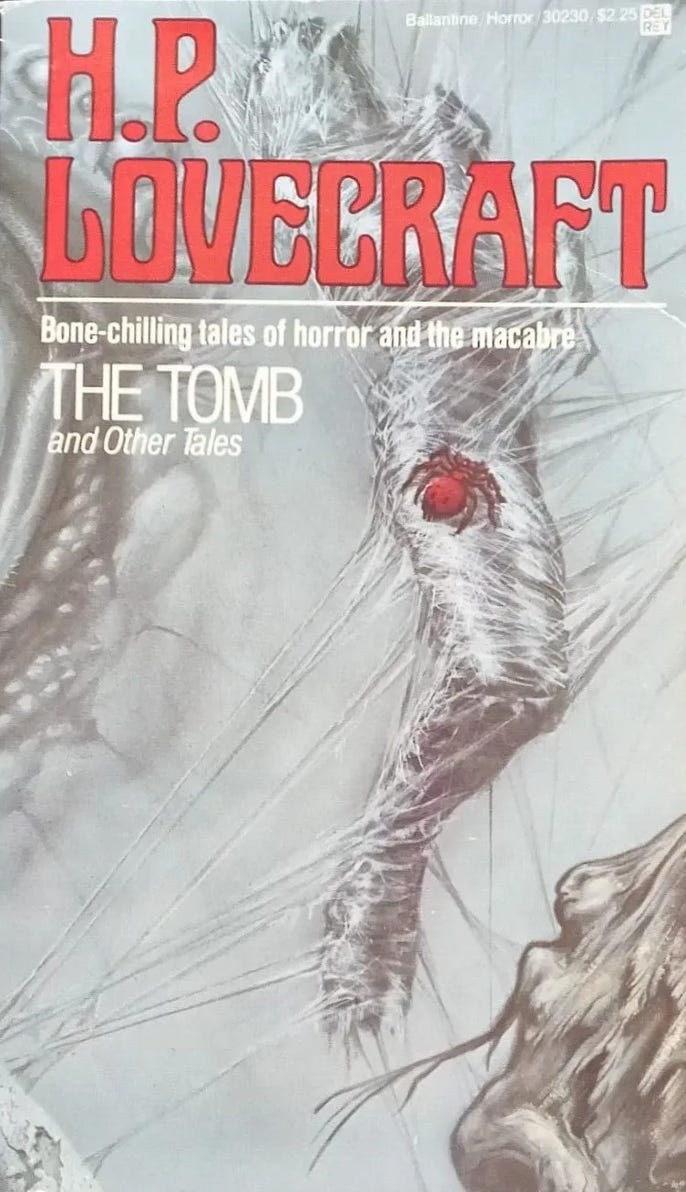
THE DEL RAY ERA - There have been many, many collections of Lovecraft’s works produced over the years by many different publishers, but to me none of them have surpassed the glorious editions published by Del Rey / Ballantine in the 70s and 80s. Graced with covers by the peerless fantasy illustrator Michael Whelan, no other versions have come close to capturing the essence of Lovecraft’s works.
My progression from Bradbury to Poe to Lovecraft tracked along with my evolution from a deeply religious adolescent into a spiritually skeptical teen. Bradbury’s works had been sweet and nostalgic, filled with candied Day of the Dead skulls and bump-in-the-night monsters beneath rubber masks that conveniently melted away at sunrise and kept away until the coming of the next autumn. Most of the victims of his stories were transgressors and sinners, people who deserved to be punished or at the very least would not be much missed in the world. With Poe, however, the stories were more nuanced and his characters more complex and morally compromised. They reveled in revenge and hubris, and although the supernatural played a role in many of his stories, there was still a grounded sense of logic to them, and the horror lay mostly in the corruption of reason in the face of terrible, unendurable losses. With Lovecraft, all of the usual conventions were swept off the table. His was a universe bereft of a loving deity, replaced by a pantheon of incomprehensible alien gods warring over the cosmos and whose actions meant death and insanity for all mankind.
Although Bradbury and Poe’s universes were more relatable in that they were populated mostly by human beings — or creatures that behaved like human beings — to my junior high mind Lovecraft’s supernatural, betentacled monstrosities felt more like an accurate reflection of reality as I experienced it. Every day I would flip on the tv and see wars, plagues, mass starvations, catastrophic natural disasters, or I would watch as my deeply God-fearing mother would once again collapse in a death faint before me through no fault of her actions — all these things only really made sense if there was a cold, irrational, and profoundly malevolent force at the controls of the universe. This is not to say that I believed that Lovecraft’s most famous creations — the creatures of his Cthulhu Mythos — were actually lurking out there in the dark, but it at least provided a plausible explanation for why the world was as troubled as it was. It was my first exposure to the idea of an alternative universe that followed different rules.
Now if you’ve got this far down into this entry, you may be wondering what the hell this all has to with game design. As I advised you in the previous entry in this series, we’re on a tiny detour here because there are things that happened during my junior high years that affected how and why I got into game design. That will be clearer once we get to the entry after this one, but if you’ll stick with me for just a quick few more points about what I learned from Lovecraft, we’ll soon get this trip back on the main road.
Firstly, I want to revisit that last sentence in the paragraph before last. “It was my first exposure to the idea of an alternative universe that followed different rules.” Now it seems like a no-brainer to fifty-eight-year-old me — or to anyone else who has grown up in modern fan culture with easy access to the internet — but at the age of twelve in the late 70s, I had not yet been exposed to the idea of a unified book of lore that collected all the rules together for how things should work in a particular universe. As I read more and more of Lovecraft’s work, I learned that his Cthulhu Mythos (Lovecraft never called it that incidentally - his friend August Derleth is the one who coined that term) had been created piecemeal as Lovecraft wrote more stories that crossed over with one another, usually only by casual references to names or events that took place in other tales. Over time, he invited friends in to write stories set in his universe or allowed them to make references to his mythos in their own tales. This group, formed by George Kirk, Rheinhart Kleiner, Samuel Loveman, James F. Morton, Everett McNeil, and Frank Belknap Long, would come to be known as the Kalem Club. In the decades that followed, other famous authors would add their own contributions to this growing canon including influential authors like August Derleth, Robert E. Howard, Brian Lumley, Stephen King, and Neil Gaiman. To this day, authors from all over the world continue to drop new Mythos stories, largely thanks to this very liberal open-door policy that Lovecraft established. It is very possibly the first shared universe that was meant to be created in this way.
The reality of this open-door policy is that the Cthulhu Mythos is an absolute mess. God — or Cthulhu — help anyone who tries to make sense of the confused narrative spaghetti that’s been created because there was no one trying to make sure that all these different ideas were consistent. Lovecraft neglected even to write down rules for himself. There are numerous contradictions even within his own stories meaning that it’s difficult to establish a narrative “truth” about anything in the Mythos.
As a young writer, I tried to make sense of all this but realized that it was important to have a plan when writing not only of where you were going, but also a record of what you’d done before. I didn’t want to have the chaos of the Mythos. I wouldn’t have a name for what this mysterious document should be called until many years later I would find a copy of a “story bible” from the original Star Trek series. I’d later use this as a lesson as I began to compile my first game design documents at Dynamix and Gas Powered Games.
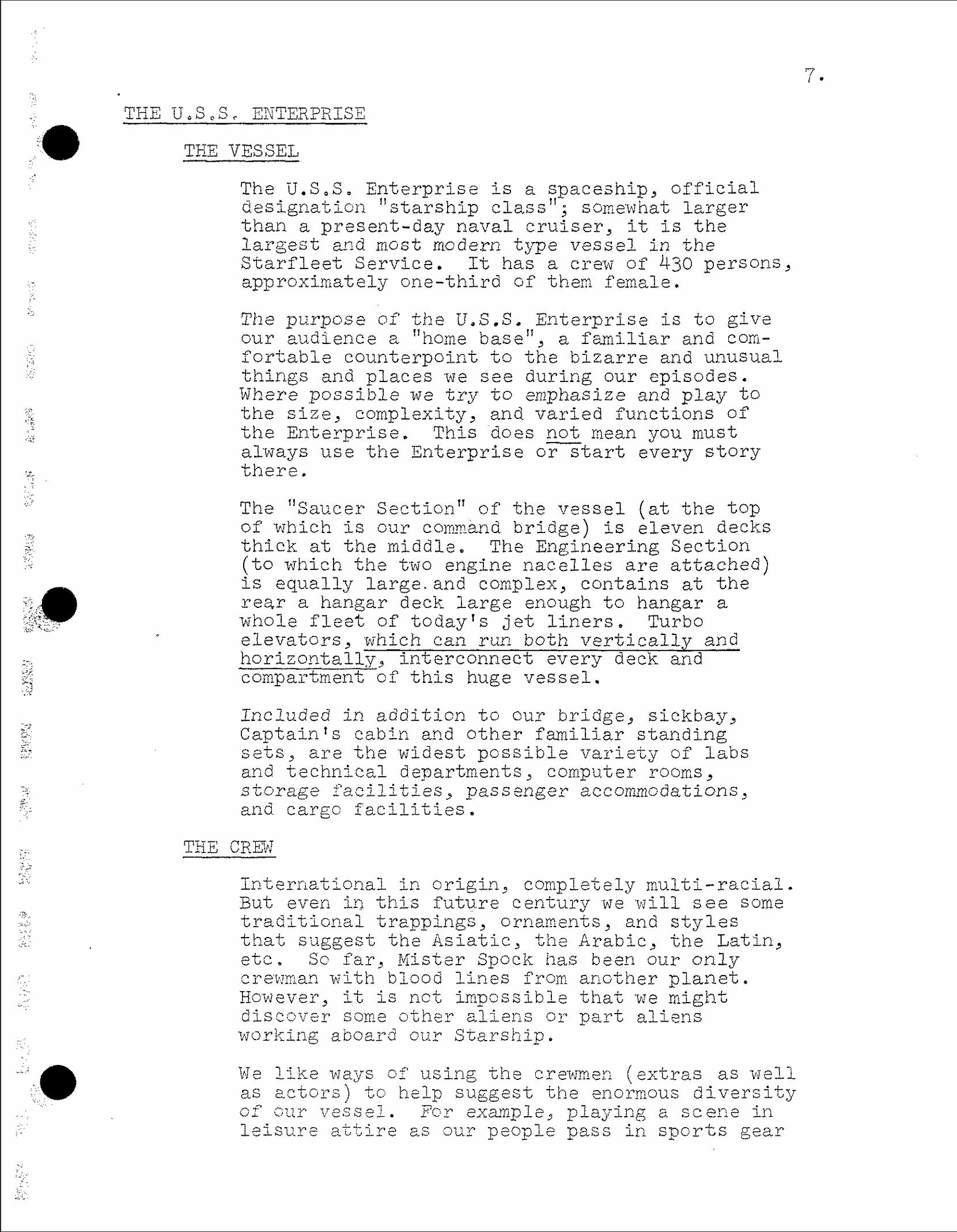
READ YOUR BIBLE - The Star Trek Guide, also called the “story bible,” was incredibly detailed for its time, and let the show’s writers know precisely what they were allowed to do (and not do) narratively, and provided deep background information not only on the characters, but also on the locations, cultures, and various props that would be used from show to show during the original run of the series.
The second and most useful narrative design device I took from reading Lovecraft had to do with the structure of some of his stories, most heavily used in “The Call of Cthulhu” and “The Whisperer in the Darkness.” Both of these tales employ epistolary storytelling - e.g. telling a story through letters, diary entries, newspaper clippings, transcripts of audio recordings, and the like. Decades before The Blair Witch Project came along, it was the literary equivalent of the found footage genre we all know in film today.
While Lovecraft didn’t invent the epistolary technique — you can go back to Bram Stoker’s Dracula or Poe’s “MS. Found in a Bottle” or even further back to ancient sources. But the technique became particularly associated with Lovecraft because he frequently employed it in stories. The advantage for him was that it seemed to lend a sort of journalistic integrity to his otherwise outré tales of monsters from beyond the stars. We feel more willing to believe what’s unbelievable because we are being given first-hand accounts of what happened, or front-page headlines from newspapers which suggests that the story can be trusted because it’s come from a reputable source (oh, for that golden age before charlatans began assaulting legitimate reporters with cries of “fake news!”)
The really important thing that this form of storytelling did was that it allowed Lovecraft to dice the narrative up into tiny pieces to subvert traditional structure. You’d never get the whole story served to you from start to finish, but instead as the reader you’d have to infer what took place between a diary entry and a news article, for example. Oftentimes he wouldn’t even present these pieces in chronological order. The structure itself was unsettling because Lovecraft left so much unexplained or unknown. He rarely placed his nightmares in full view, but instead he threw impressions and half seen things at his readers, peppering his stories with peculiar adjectives that left the reader to interpret for themselves what the hell an eldritch horror actually was.
Now you can probably imagine where this technique might be of great interest to a nascent narrative designer. It’s storytelling without a linear narrative that stitches together all the expository bits. Instead, it’s up to the reader — or in my case a player — to take a mosaic of information found in different places and gathered potentially completely out of order, and figure out the story as though it is a mystery to be solved through exploration. Rather than relying on diaries and news articles, I could employ a combination of dialog, object descriptions, notes left between characters, even fragments of history books to compose what was essentially an emergent narrative experience. I’ve employed this technique in every game I’ve ever built, and it’s an approach that you’ll see used everywhere across the industry.
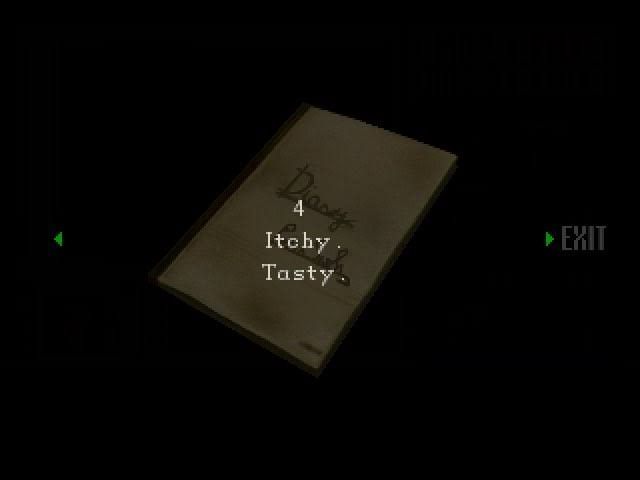
MADNESS TAKES ITS TOLL - When I think of other games not made by me that leaned heavily into epistolary storytelling, the deliciously Lovecraftian OG Resident Evil is at the top of the heap. The zombie-infested mansion is littered with the diaries of the scientists who were trapped inside as they slowly lost their minds and bodies to the T-Virus. My favorite entry to this day is the final message: “Itchy. Tasty.”
The third and final point I need to make about Lovecraft’s stories is that my love for the Mythos would in a few years lead me to a role-playing game that in turn would help me land my first job at New World Computing. But that story — and its place in the link of the overall chain of causality — will have to wait a short while longer as we take one more literary detour through my years at Central Junior High.
#Games #Writing #Horror #Bradbury #Poe #Lovecraft #StarTrek #ResidentEvil #NarrativeDesign
I REALLY REALLY loved this entry.
Favorite bits-
-Aha, so THAT'S why you love horror so much!
-Your love of Call of Cthulu makes so much more sense now.
-Don't think i didnt see the reference between spaghetti, the word, being used to infernal god and a tentacled godlike being. Easter Egg!
-Resident Evil, the 1st game on PS1 was VERY SCARY and I loved it.