
From Gamer to GameDev: Part V
1978: The Year I Made Contact

RYLAN BURSAR: Return the money, Centauri.
CENTAURI: Return the money? Are you delirious? Do you know how long it took to invent the games? To merchandise them? To get them in the stores by Christmas?
GRIG: It must be terribly embarrassing for you, and I do sympathize. However...
CENTAURI: But I saw him fight! He could be the greatest Starfighter ever!
ALEX ROGAN: That was just a game, Centauri.
CENTAURI: A game? You may have thought it was a game, but it was also a test. Aha! A test! Sent out across the universe to find those with the gift to be Starfighters. And here you are, my boy. Here you are!— From The Last Starfighter (1984)
When I trudged into the Salvation Army community center in the fall of 1978, I wasn’t there for fun. My doctor had determined I was a bit too husky — which was the polite, seventies way of saying I was a fat ass — and I needed to get more exercise. Thanks to the asthma that had dogged me through elementary school, my options were limited. Too much exertion and I could land for the millionth time in the emergency room, jacked full of needles and adrenaline to keep my airways open. (Not a fun time. Do not recommend. Zero stars.) Most traditional sports were out of the question for me, and although I was in marching band, the doctor wanted me to have a physical activity that I could do on my own schedule, and at my own pace. Preferably something I enjoyed doing so that I’d keep at it. I thought maybe I could try swimming at the Salvation Army community center they’d recently opened across the Arkansas River in Prattville. So when my mother at last dragged me through the front doors, my only expectations were that I’d do a few thousand laps around the pool until all the ugly melted off me and at last I’d look like a shorter, brown-haired version of Aquaman (the Superfriends version, not the Jason Momoa one that rendered such aspirations unobtainable for we mere mortals). What I had not expected was to clap eyes on a strange, high-tech artifact in the community center lobby that would prefigure my future career. What I saw was an arcade game.
Now for my readers who are Gen Zers or even millennials, I need to explain that until that moment, I had never seen a video game of any kind, let alone an arcade game. Sure, I’d witnessed Chewie and C-3PIO playing some kind of weirdo pre-cursor of Battle Chess in Star Wars the year before, but that had been a faked simulation, and it bore no resemblance to the mysterious cabinet that was calling so seductively to me from across the room.
The game I’d discovered was called Space Wars, and it featured a hero ship that looked suspiciously identical to Star Trek’s U.S.S. Enterprise (without having any other identifying marks that could have got the makers sued by Paramount). In this era before joysticks became omnipresent, everything was controlled with a simple bank of square buttons arrayed beneath the screen. In design, it was no-frills and completely simple, but to me it played right into my fantasies of being the captain of my favorite starship and I instantly became a hundred percent addicted to it.
One of the oddest things about playing that first arcade game was how quickly I figured it out. It’s not like I had any direct previous experiences to compare it with. It was vaguely like driving a radio-controlled car, but significantly much more complex in functionality since you’re not just steering it but controlling thrust, controlling rotation, firing torpedoes, avoiding enemy shots and all the while dealing with the effects of gravity and inertia. It was a significant step up cognitively, and yet I took to it almost instantly. That’s not to say I became any kind of bigshot wizard with it. I never had enough quarters or time to get really good at it since I was supposed to be spending my time at the community center in the pool and not parked in front of the machine. Nonetheless, it became the primary reason I wanted to come back every week.
Another really interesting aspect of Space Wars was that the players not only had the power to change the game’s difficulty, but also the game’s environment. You could decide whether the player’s ship and missiles bounced off the edges of the map, or whether they wrapped around. You could create a black hole in the center of the map that would suck in and destroy anything that got too close, or create an anti-gravity star that deflected anything passing through the center region of the map. It was an entirely unique feature that to the best of my knowledge would not be seen in any other arcade game ever again, or at least not in such an obvious form.
Space Wars would go on to become one of the most influential early arcade games, and was the first coin-op machine to ever use a vector graphics system. It was so revolutionary that Atari — rather brazenly — directly lifted the look and several of Space Wars’ core features for Asteroids which they released in 1979. Cinematronics responded by hitting Atari with a lawsuit claiming patent infringement, but the results of the suit did nothing to stop Asteroids from going on to phenomenal success. Within a few years, several legendary games like Star Castle, Tempest, Battle Zone, Lunar Lander — and even 1983’s hits Star Wars and Star Trek: Strategic Operations Simulator — would all use the same vector graphics system pioneered with Space Wars.
The lessons that I would take away for my future career were twofold. Firstly, when thinking back on it during my early days in the gaming industry, I remember feeling that I’d been just a tiny bit more invested in Space Wars than I’d been with any of the other arcade games that I played thereafter. Initially, I assumed it was because it had been my first arcade game. That certainly had to be part of why I liked it a bit more. First experiences, first loves — those things get under our skins and color our perceptions in a way that other things don’t. But the more that I thought about it, I realized there’d been real power in getting a little taste of control over the game environment, even though it was just allowing me to tweak a couple of basic rules. By letting me control just those couple of things, I was no longer just a player, but a collaborator in the experience which also gave me the tiniest sense of ownership.
My second lesson had to do with experiential learning. I hadn’t needed to spend twenty minutes running through tutorials or reading a rule book before I could start playing. Even with relatively simple traditional board games like Clue and Monopoly, you still had to spend at least a few minutes beforehand plowing through instructions. But with Space Wars, once I’d dropped in my quarter and hit the start button, I was in the game. I learned how to play the game…by playing in the game. When I did things wrong, I blew up. When I did things right, I scored points. Although the games that I would go on to develop would be much, much more complex and have rulesets that were much more abstracted, I always found myself going back philosophically to that first experience with Space Wars. I have always tried to create games that let players jump in as quickly as possible before bogging them down with blind decisions and hours of character class research that’s meaningless until the player’s actually had the opportunity to see how things work in the game. To this day, I am a strong believer in teaching players what they need to do and introducing features progressively, as needed, as the player moves forward into the experience.
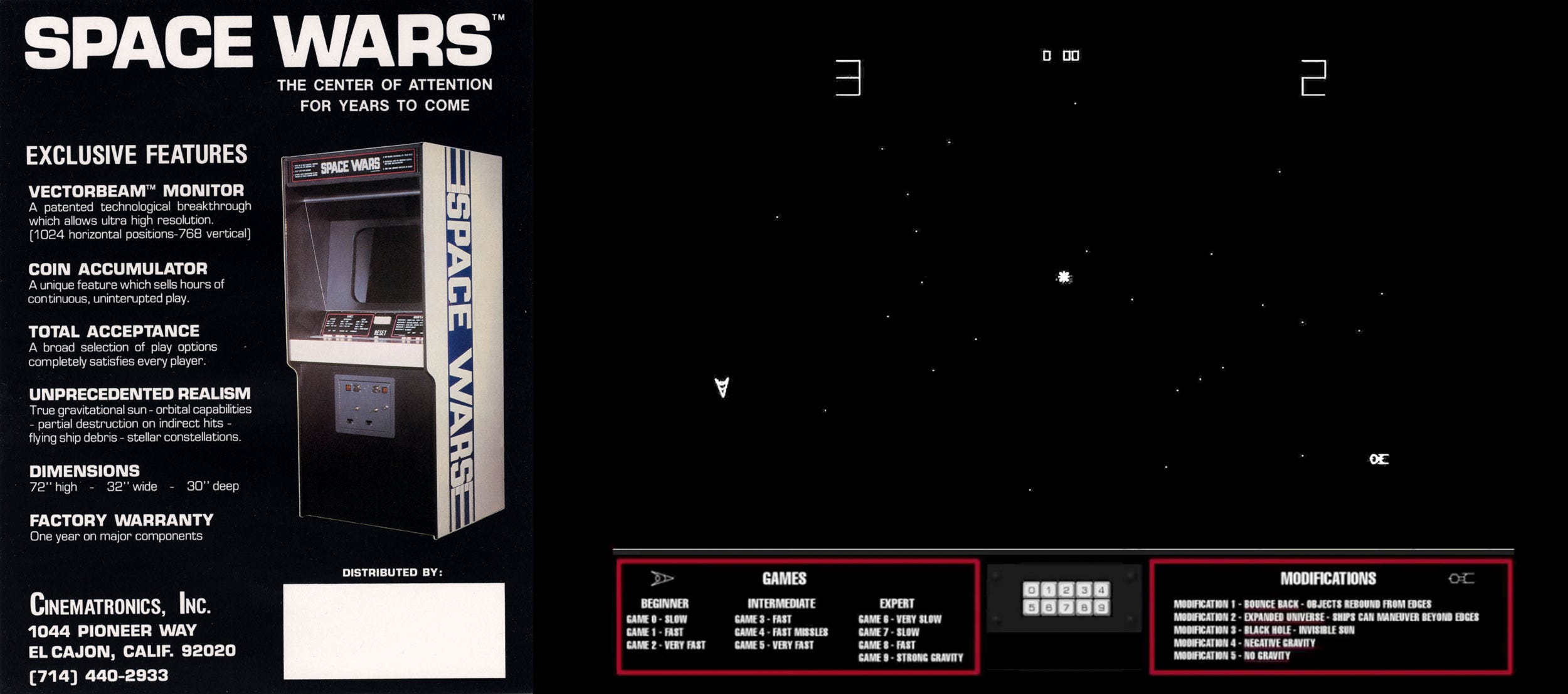
PEW, PEW, PEW! - Created in 1977 by Cinematronics, Space Wars became the best-selling arcade game of 1978, moving over 10,000 machines in its first year on the market. It was based on the PDP-1 computer game Spacewar! created by J. Martin Graetz, Wayne Witanen, and Stephen R. Russell who first demonstrated it at MIT’s May Open House in 1962.
The problem I had as a teenager with developing a habit for Space Wars — and all the other arcade games that followed soon after — was that I always needed money. If I’d been like a lot of other kids my age, I might have been allowed to get a part time job, but my parents didn’t want me to be distracted from my schoolwork and forbade me from entering the work force until I was at least sixteen. And thus, the dollars’ worth of quarters that my mother parceled out to me as reward for doing pool laps turned into a kind of sad Pavlovian exercise. Do my laps, get my quarters, get my momentary fix of electronic glory. To this day, I can’t look at a pool or smell chlorine without thinking about blasting aliens in Space Wars.
Unsurprisingly, over the next year as the pounds did not just fall off my frame, and since I couldn’t make as many trips to the community center when I was busy with my classes, I grew frustrated with the whole grind. I wanted to be able to play games without always having to perform for quarters, but the most obvious solution for my problem was something that was well outside of my reach. The first home gaming console — the Atari Video Computer System (later rebranded as the Atari 2600) — had debuted for $200 which would have been the equivalent of about $900 in today’s money — far outside of what I could reach with my $3 a week allowance, and there was no way I could have convinced my parents to drop that kind of money for something so frivolous. (You can’t imagine how envious I felt when, a year later, I found an Atari 2600 in the bedroom of my cousin Mark Bovis).
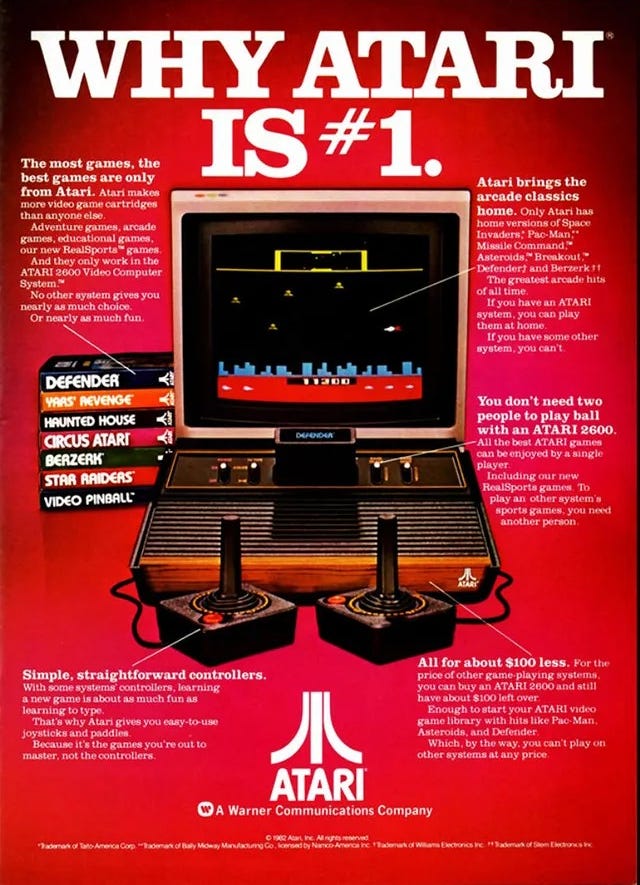
DREAM MACHINE - The Atari 2600 was the first commercially successful home gaming console, and played a major role in turning Gen Xers like myself into the first true gamer generation. I remember a lot of hours playing Pong, Break Out, Missile Command, Space Invaders and many others on my cousins’ machine. I wouldn’t own a dedicated gaming console of my own until 1992 after I’d started working at Dynamix. As one of my first purchases after moving to Eugene, I bought a Sega Genesis.
While a fancy game console wasn’t in the cards for me, I’d become fascinated by a little toy that seemed to be everywhere after I’d discovered Space Wars. It was a small, handheld, beige-colored gadget that had become the bane of every teacher at Central Junior High. While our instructors were trying to teach us about important things like math, and chemistry, and that batshit crazy Oklahoma governor that declared war on Texas that one time, it seemed like there was always someone in the back of the classroom with one of these devices beeping and booping and generally interrupting lectures. Easily, these doohickeys became the #1 most confiscated objects on campus. And so, many years before tamagotchis and cell phones arrived, Mattel Handheld Football ushered in the age of mobile distraction.
In truth, I wasn’t initially as enamored with these gadgets as I could have been because they were supposed to be emulations of sports games, and I was a card-carrying member of the I Hate All Sportsball Club. Why would I want to play an electronic version of a game that I didn’t like in real life? But the absurdity of the situation was that if you removed the label, and you got rid of the simulated grid of the football field, and the molded plastic around the screen that suggested a football stadium, there wasn’t really much there. All the players and the ball were just represented by the same red LEDs. They just as well could have represented chess pieces, or spaceships, or orcs, or a field filled by Sponge Bob SquarePants and his friends. I thought about how much emotional investment that a player can make in a token if it’s framed with a specific fantasy. If you tell me the red dot is a quarterback, I don’t care what happens to it. If you tell me the red dot is the Enterprise, then suddenly I care a great deal about it getting safely across the quadrant. The narrative context can make all the difference between engagement and apathy.
For Christmas of 1979, I didn’t find a Space Wars arcade machine sitting next to our Christmas tree. I also didn’t find any version of an Atari game console connected up to our television set. But what I did find was a hardback sized package that contained an electronic handheld game called Space Battle. Like Mattel Handheld Football, all of the action was handled with little red LEDs, but in this version, spaceships were exchanging torpedo fire across the screen rather than football players tossing around pigskins. It was incredibly simple and super cheap, but it was the first electronic game I’d ever own.
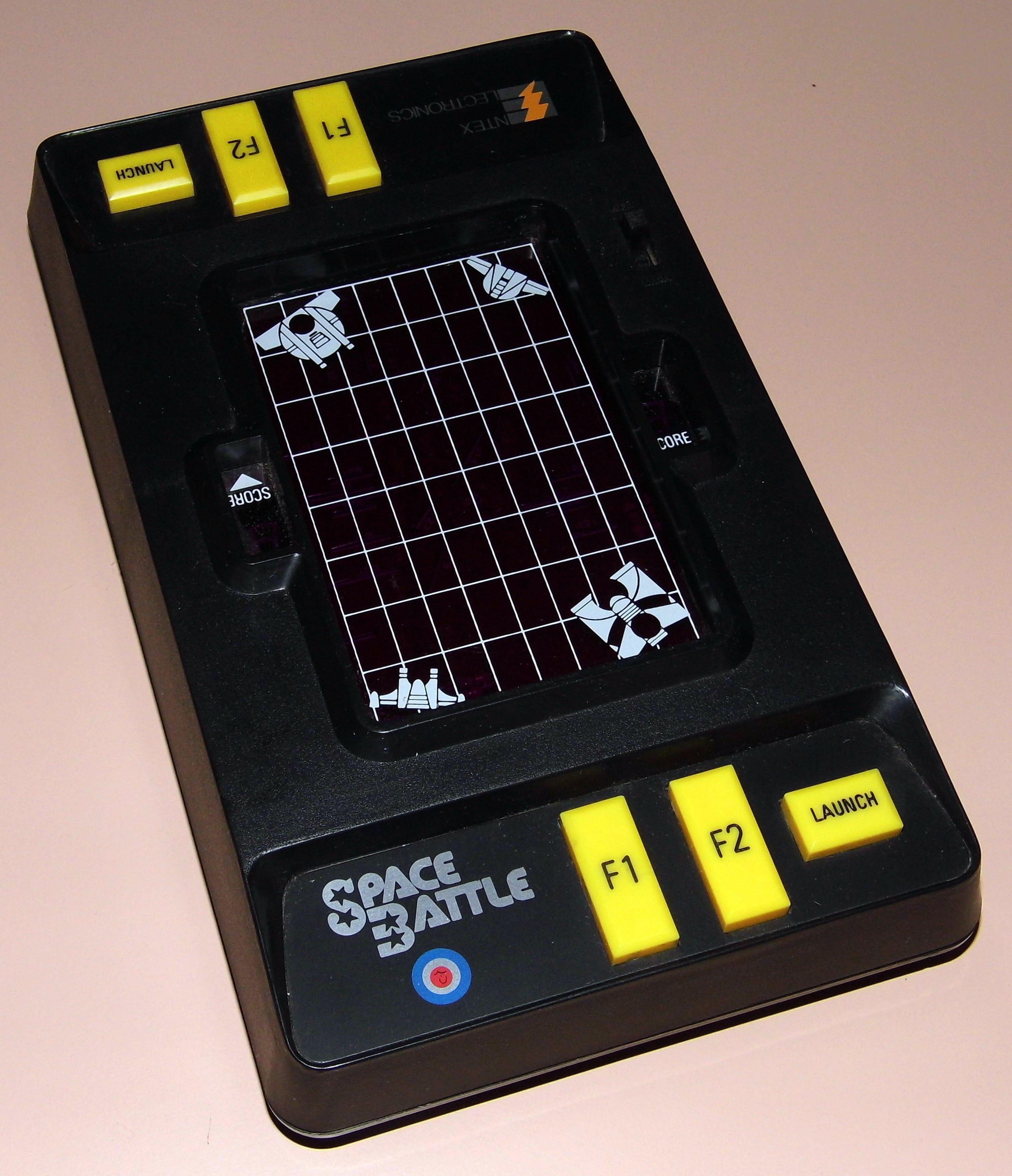
MISSLES AWAY! - Produced by Entex in Taiwan, Space Battle was released in 1979.
#Games #GameDesign #GameHistory #RetroGames #SpaceWars #Atari #Entex #Mattel #Cinematronics #VectorGraphics
I loved seeing your history of how you grew to love video games. I also like how you described re imagining the football game as getting the enterprise across a quadrant. This was just an unabashed trip through your memories, and entries like this are just as nice to me as ones related to your work.