
From Gamer to GameDev: Part VI
Your Honor, the Gnome Had It Coming
Steve Garrett likes to pretend he’s an ordinary guy. He’ll tell you he’s just a John Cougar Mellencamp-lovin’ small-town boy who now works as a humble civil servant in a small Kansas municipality. He might tell you his local hero stories about playing in a rock and roll band when he was a young man, or regale you with his favorite historical anecdotes about friends and family from back home. But don’t let his act fool you. If you give him a look — a really good piercing inspection — you’ll see his dark eyes full of hidden depths and mystery, see the shaggy, snow-streaked wizard beard, and his ever-present smirk that tells you he’s in on a joke that no one else knows. The truth is, Steve is illuminerdi, one of Oklahoma’s secret masters of geekdom. He’ll deny it all, of course. The best ones always do. He’ll wave his hand and proclaim, “I am not the droid you’re looking for,” or “I’m not one of you,” but I know the truth. I was there. From my earliest days, he was slowly and surely dragging me across the geek frontier.
Steve and I met when I was in early elementary school. He was a next-door neighbor to my grandmother and Uncle J.L. in Stilwell, and I’d see him about twice a month when my family drove down from Tulsa. We became friends because he was so frequently in and out of J.L.’s house that we pretty much considered him a member of the collective Hallford household. Given that he was about my age (he’s a year older than I am) and the only kid around for me to play with on a regular basis (apart from my cousin Joe Dotson who would occasionally turn up in town at the same time), we naturally fell in together.
I remember being captivated by Steve’s trampoline. His family was the first I ever knew that privately owned one, and weirdly enough it always somehow became the center of our games of Army or cowboys and Indians. In retrospect, it strikes me as funny that Steve ALWAYS insisted on being one of the cowboys in those scenarios rather than one of the Indians. While Steve and I are both Cherokees by birth, Steve is significantly more genetically Indigenous than I am, and also much more closely resembles what most people expect a Native American to look like. And maybe that’s the answer. When we were growing up, the Indians were almost always portrayed as the bad guys in movies and on television, and the cowboys were always the heroes. Steve definitely wanted to be the hero in whatever was going on.
The more time that I spent with Steve, the more I became convinced he wasn’t just the hero, but also one of the coolest guys I knew. He was seriously into comics, more so than anyone I was growing up with back in Tulsa. He took them so seriously that he was teaching himself how to create them, and I remember my amazement as I flipped through the pages of his comic Grocery Man featuring a hero of his own invention. (Later on, he’d use this skill to create a weekly humor comic strip for the Stilwell Democrat Journal.) He was also the first person I knew that had a complete (and pretty darned amazing) Captain America costume that hadn’t come out of a box, but had been custom made for him (I presume) by his mother. Every time I went to see him, it was a bit like visiting a tiny little Comic-Con with Steve as the one and only featured guest.
Of course, not everything we did revolved around our strange trampoline-centered war games or our long, digressive arguments about whether Marvel or DC had the superior superhero line up (I’m still team DC thanks to the Justice League of America + Justice Society of America, but I did love Spiderman and Doctor Strange from the Marvelverse). I remember playing a fair number of board games with Steve, but I’m a little fuzzy on what all he had on hand. I seem to recall Connect 4, Checkers, and maybe Battleship. There might have been a Stratego mixed in there too. He definitely had The Game of Life because I always see his den when I think about that gameboard, and I only ever played it with him. In truth, I probably would have tried anything that Steve put in front of me because as the arbiter of all things cool, I trusted his recommendations about games as much as I did everything else.
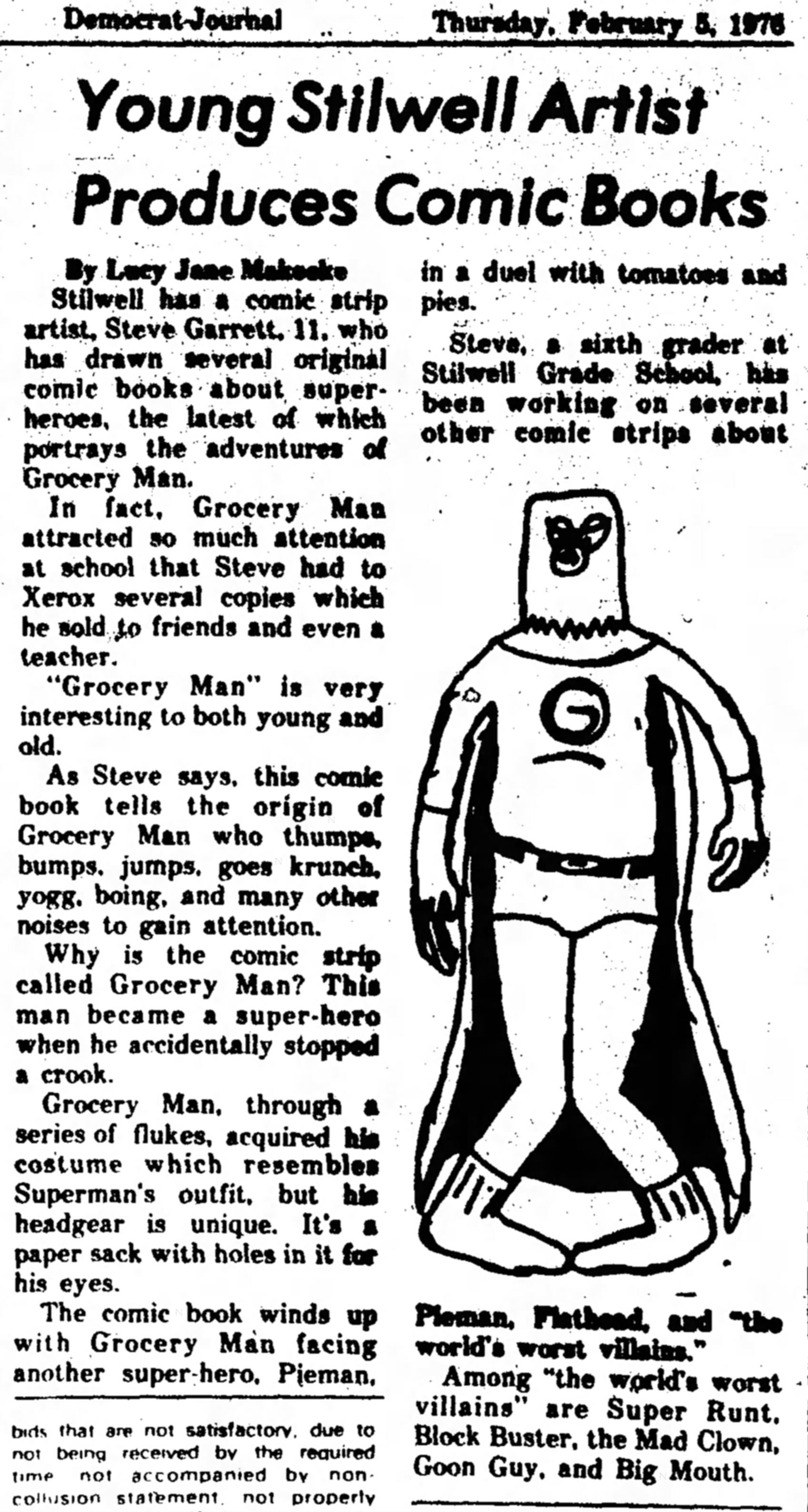
ORIGIN STORY - Steve’s art and his writing skills would be a little more sophisticated by the time he got around to creating his humor strip for the Stilwell DJ a few years later, but Steve’s love of heroism and fighting for the little guys was on display from very early on.
About three years after Grocery Man got its glow up in the local newspaper, I was visiting my Uncle J.L. in his new, purpose-built home that he’d moved into after marrying my Aunt Marianna. The new place wasn’t far from where he’d lived on Chesnut Street — only a couple of blocks, an overgrown crick, and a church parking lot separated the two houses — but I could no longer casually stroll next door to see Steve whenever I wanted. Now our visits had to be coordinated via phone call whenever my parents and I rolled into Stilwell. On the occasion in question, Steve told me that he had something new to show me, and wanted to know if he could bring it over to J.L.’s place. Naturally I was intrigued. Any recommendation from Lord Garrett was always worth checking out.
Once Steve arrived, he joined me in a back bedroom where I was busy playing something on my cousin Mark’s Atari 2600. After making some snarky remark about my less than dazzling reflexes, Steve tossed a box on the bed next to me and said, “Here, check this out. It’s called Dungeons & Dragons.” Although I liked the cover of what he was showing me, and the name was certainly evocative, a part of me was the tiniest bit wary. I was still a relatively new convert to fantasy fiction thanks to my brother’s rather strong-armed tactics in getting me to read The Hobbit. But given its name, presumably it had something to do with dragons, and I was interested in anything that involved fighting big scaly monsters. Putting aside my joystick, I settled back and Steve began to explain the whole concept of a role-playing game.
At the start, I liked the sound of it. I liked the idea of roaming through dungeons and gathering treasure and solving puzzles. I liked that I could be a hero and vanquish monsters. I really liked the idea that I could play a wizard and use magic. I totally saw why Steve who was the champion of all that was heroic got into this. All of it sounded amazing…but then it all started to get complicated. There was all of this other stuff I had to do before we could start playing. I needed to read a booklet to understand what a wizard was in the context of D&D. I needed to pick a race which would impact any additional abilities or handicaps. Rolling up a character (dice? these dice are weird, but cool) was fun, but what are attributes? What’s the difference between Intelligence and Wisdom (is this a Zen thing?)
Just write everything down on this character sheet Neal, and give him a name.
“Okay. He’s an elven magic user named…I don’t know…Ralph, I guess. I don’t know how elves name themselves. When do we get to the fighting monsters part?”
Choose an alignment.
Well he’s a good guy, right? I mean I’ll be fighting monsters. If he were evil he’d be the monster.
You still need to buy equipment for your character.
“Equipment? How do I buy equipment? I have money, like Monopoly dollars? Are there dollars in the box or…No?”
You have this amount of money listed here, and you just pick things off the equipment list.
“Great. So…I’ll buy a sword and chainmail!”
You can’t use either of those things. You’re a wizard, so you can’t wear any kind of armor or use any kind of sword. It’s in the rules.
“I…what?! I have to go in unarmed?”
You can take a staff.
“TO FIGHT AGAINST DRAGONS?!?!”
Fifteen minutes in, we haven’t actually played anything. We’re still learning rules. As Steve begins to read the rules about how combat will work, I start to realize with horror there’s going to be math involved. Bane of my existence. I was struggling through the worst math class of my young life, 9th grade Algebra, taught by a tyrannical old battleaxe named, of all things, MRS. SPARKS. She wore gallons of an unmistakable perfume that smelled exactly like burning wood, and you’d smell her Satanic majesty just passing by the open door of her classroom. If dragons could actually shapeshift into human form, she was clearly a math dragon.
Finally, after we get through the basics, I’m ready to go. I’ve got my character, I’ve got my stuff, and I think I know how to fight whatever Steve is going to throw at me.
“Okay, great! Get the game board and the player tokens out of the box.”
There isn’t one. I just describe everything to you as we go along.
“Well, how do I know where I can move or where I’m going?”
You’ll have to draw a map. [He hands me a pencil] Trust me.
I remember almost nothing of the actual adventure that followed. I don’t know if he was working off the sample dungeon in the back of the rules guide, or if he was just making up something new as he went along. Mostly I just remember having fun. I enjoyed his descriptions of things as I blundered through a dungeon doing increasingly stupid things. I loved the narrative, the back and forth, the glint in Steve’s eyes when I would ask if I could do X, Y, or Z and then hearing, for the first time, the classic Dungeon Master refrain, “You can certainly try,” and then reaping the rewards or punishments after I made an appropriate dice roll. In the end, I never met a dragon in that one — and only — D&D session with Steve. My recollection is that I made one stupid decision too many and I think Ralph…or whatever dumb name I gave him…sprang a trap that he couldn’t recover from and came to an ignominious end. But it didn’t matter. Steve did what destiny had appointed him to do. He had once again introduced me to something new, and it set me firmly on the road for more role-playing adventures to follow.
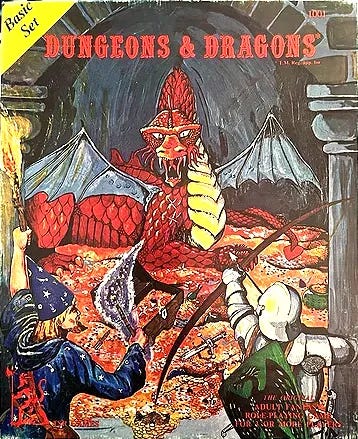
BY JEEVES, HOLMES! - Although the first version of Dungeons & Dragons created by Gary Gygax and Dave Arneson was released in 1974, the Dungeons & Dragons Basic Set (also sometimes called “The Holmes Version”) played a key role in D&D’s growing influence in the late 70s and early 80s. Edited by Dr. Eric Holmes and released in 1977, the Basic ruleset streamlined the experience to help introduce players to the core concepts of D&D, and limited players advancement up to 3rd Level. Beyond that, players were expected to learn the more complex version of the game — known as Advanced Dungeons & Dragons — which hit the market the same year as the Basic Set.
In introducing me to Dungeons & Dragons, Steve had both done me a huge favor and also burdened me with an equally huge problem. I wanted to play more, but Steve was the only person I knew that owned the game or knew the rules. Although I was still travelling to Stilwell with my family on a regular basis, we weren’t going down nearly as often as when my grandmother was still alive, and there were no guarantees I’d even be able to reach Steve whenever we were in town. After much consternation I realized that if I ever wanted to play D&D again, I was going to have to take the initiative. I’d buy the game, learn to be a Dungeon Master, and then recruit my own group of players. How hard could all of that be?
The first lesson I had to learn was that D&D still wasn’t on mainstream radars just yet. You couldn’t buy it at Sears, or J.C. Penny’s, or T.G.&Y. and even the big bookstores like B. Dalton and Waldenbooks wouldn’t be carrying it for years. It was only after harassing several businesses listed under the “Toys and Games” section of the local Yellow Pages that I finally found a place that said they had it in stock.
Discovering The Game Shop in the Farm Shopping Center in south Tulsa was a bit like walking into Narnia for me. They had every kind of game imaginable on their shelves: chess, checkers, puzzles, backgammon, poker supplies — all the stuff you’d expect to find in the toy aisle of any reasonably stocked department store — but they also carried the hardcore tabletop stuff too. Gamer games. Napoleonic Wargames. Starfleet Battles. At the back were two whole shelves solely devoted to RPGs — not just D&D — but Traveller, Runequest, Gamma World, and several others. Before that day, I’d had no idea that role-playing games weren’t just Dungeons & Dragons, but a whole genre. I felt like I’d discovered the gamer’s version of the Library of Alexandria.
After plonking down four weeks of hard-saved allowance money on the Holmes D&D Basic Set, I went home to study The Fine Art of Dungeon Mastering (it was even described in those exact terms in the rulebook). While playing with Steve, it had just seemed like an elaborate form of storytelling, but as I read further, I learned there was actually quite a bit more to it. I needed to think about balancing the difficulty of different encounters based on how many people were playing. I needed to manage what the players and monsters could do based on diseases, time, movement speed, encumbrance, lighting, terrain features, and other obstacles. There was a whole plethora of accounting that needed to be going on (ye gods! math again!) that I hadn’t been paying any attention to while playing with Steve (though to be honest, I don’t know how much of that HE was tracking while running HIS session). Even ignoring all of that, I knew that any game session needed to be well thought out in advance. I needed a complete map of any place the player could likely end up. I needed a likely plan for how each adventure would unfold, taking into account not just the most obvious choices that my potential players were likely to take, but also alternative things they might try to do. I needed to think about how different parts of the story were interconnected. What should happen if they triggered event D before trying thing A? I started to see that a truly well-developed game structure was a web rather than a straight line or even a simple branching narrative. In short, preparing to DM even the simplest session meant I needed to do hours of work before trying to run anything for someone else.
Abandoning my initial thoughts on whipping up a whole new adventure from scratch, I turned to the scenario The Keep on the Borderlands which had been included in the box of the D&D Basic Set. Set in Gary Gygax’s Greyhawk universe, Keep was worked out with almost excruciating detail (though much skimpier on the narrative aspects than what would be expected for scenarios published later). Unlike Steve’s session, the scenario was littered with non-player characters to be controlled by the Dungeon Master, i.e. me. Potentially there were dozens of characters that I’d have to voice, which brought a whole other level of complication to the experience. On top of everything else I had to do, I’d have to be an improv actor, and I’d have to remember everything I told the players. I began to appreciate that being a DM was a crushing, nearly impossible job…but still, I wanted to give it a try.
The hurdle I needed next to clear was to find someone — ideally several someones — that would be willing to let me run them through a session. My difficulty was that I had virtually no close friends, or at least not the “come over to my house for three or four hours while I run you experimentally through this weird story game thing” kinds of friends. I had geeky people I knew at school, but we never hung out off campus. I’d never even been to the house of any kid that I hadn’t gone to elementary school with, and inversely, no one was really welcome to come be at my house either. The protective bubble that my parents had so carefully erected around me in elementary school meant I had few opportunities for socialization outside of my family. There was really only one kid at all that I knew who might let me run through a session with him at his house — my longtime friend, neighbor, and first gaming partner, David Guthridge.
To be fair, I don’t think David had any real interest in D&D. Like at all. I’m not sure if he even read the Lord of the Rings, though I do know he’d read further through the Chronicles of Narnia than I had. He wasn’t really a Trekkie, but he’d probably learned enough about Star Trek via the osmosis of listening to me rave that he knew who Kirk and Spock were, and what the general gist of the show was (and a few years later we went together for at least one screening of Star Trek II: The Wrath of Khan). Over the years, he tolerated a lot from me just in the name of being my good friend even when I was too intolerably weird for anyone else to put up with for any extended period of time. So, when I asked him if he’d let me DM a game of D&D for him, he gamely said he’d try whatever I wanted him to do.
For the sake of the session, I opted not to try and have everything memorized beforehand. There was simply too much for me to have to know. I treated it instead like an open book dress rehearsal, and blatantly kept the Keep on the Borderlands scenario open on the Guthridge’s dinner table. I made no attempts to hide that I had no clue what I was doing. Leading David through character creation was simple enough — he just followed my suggestions — and then we plunged on into the action. It wasn’t a particularly stellar experience for either of us. He’d make a choice, and then I’d stop everything for several minutes to flip through my reference materials to see what should happen next. Probably the best moments came when we would burst into Monty Python-inspired accents for silly conversations that veered wildly away from the plot of the game. Finally, after an hour or two of erratic gameplay and bad acting, the game came to screeching halt when David’s mother wanted us cleared off her table so that she could make dinner. It would be the last D&D game I’d try to run for quite a long time, and I wouldn’t pick up my multi-sided dice again until my junior year in high school.
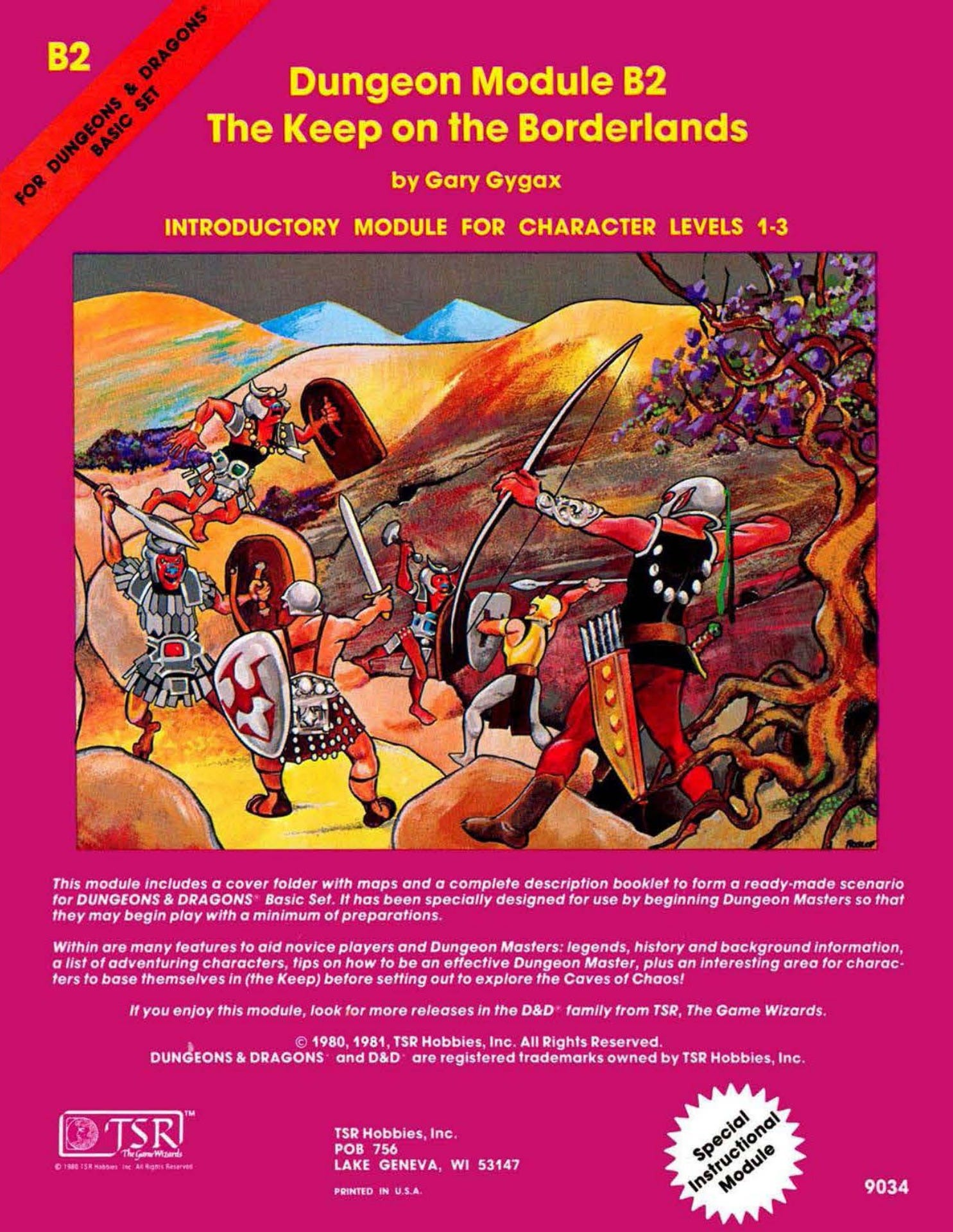
SCENARIO - “The Keep on the Borderlands,” written by D&D co-creator Gary Gygax, was the second module to be included in the D&D Basic Set, and was introduced in December of 1979 to replace the previous module, “In Search of the Unknown” by Mike Carr. Over the years, “The Keep on the Borderlands” became one of the most played early D&D modules of all time, and a revamped and updated version of it, retitled “Heroes of the Borderlands” is now included with the D&D 5.5 Starter Set.
Hidden behind his Dungeon Master screen, I can only see the top of James Day’s head and he leans down to consult his map. After a tense moment, he looks up and consults those of us collected around the table.
“So, have you decided what you’re going to do?”
We all exchange grim-faced scowls. Nick Luedtke announces the party’s decision. “Use the gnome.”
“Damn it!” Steven Chesbro is up on his feet, objecting to the abuse of his character, but the rest of us have voted for this. The little chaotic evil bastard has tried robbing us once too often during this session, and we’ve figured we can at least put the little larcenous prick to good use. It’s a shame his character isn’t a dwarf because they’ve got thicker skulls, and less likely to die in the process of being used as a battering ram.
From his place on the sofa in the living room a few feet away Marty — Nick’s dad — shouts out a question about his character versus Nick’s. Nick does a fast consultation and tells Marty that his character, a Half-Orc, has a better strength bonus at the moment. Nick should be the one doing the battering with Steven. James nods sagely, and begins trying to calculate what the appropriate roll should be for gnome skull versus door.
“I’m tellin’ ya, don’t do this,” Steven warns the rest of us, but we’re all rolling our eyes. It’s still too early in the day to be at this stage. Usually this sort of thing happens much later, around dinner time, when we’re all starting to get a little punch drunk from playing all day. But it’s barely half noon and we’ve only been playing for about an hour. Behind his screen, James is mumbling, looking for the appropriate table. It sounds a bit like an incantation.
Claudia, Nick’s younger sister, bounces in from the back of the house and asks if she can get anything from the fridge from us. She’s not officially part of the gaming group, but she often cheerfully plays hostess on the days that the Luedtke family lets us invade their dining room. She goes around the table as we all call out our drink orders. “Pepsi!” “Pepsi.” “Water for me.” “Mountain Dew!” “Pep-”
“HASTUR! HASTUR! HASTUR!” Steven is bellowing, wild-eyed, MANIACAL. He’s pointedly turning his insane smile around at the rest of us. Virtually all of us sag with a groan, with the exception of Franklin Oaks who throws back his head and laughs along with Steven, even though his character’s just as likely to pay for this idiocy along with the rest of the party.
I look at James and shake my head. “Don’t do it, man.”
James shrugs. “I have to. He said the name of He Who Shall Not Be Named. It’s in the Deities and Demi-Gods Manual.”
“Don’t!” As one, the rest of us lean over the table and crowd James. “Doooooooooon’t dooooooo it!” but James is already rolling for the check. For a breathless moment we all watch as the dice bounce, bounce, bounce —
And thankfully, we’re all safe. He Who Should Not Be Named has not heard, or he is choosing not to respond to Steve’s summons. Even before Steve can say anything else, Nick commands, “We stuff a rag in his mouth!” and that’s the end of the issue for the moment.
With the danger passed, the rest of us declare a bathroom break and heave up from the table, with a few of us heading down the hall to form a queue. I stay put and turn my attention to Ron Bolinger, the quietest and newest member of our D&D group. He’s got large dark eyes, and he’s somewhat nervously glancing around the room. I think he’s trying to get used to this, to this madhouse of a group. Like the rest of us, he’s a member of the Charles Page High School marching band, and a damned good trumpet player, but he’s by far the most introverted among us. “So, what do you think of all this?” I ask him.
“It’s all right,” he replies. There’s flicker of a non-committal smile on his face, and then it’s just as quickly gone.
I don’t know Ron well enough yet to know if he’s actually okay with being here, or if he’s politely trying not to show us that he’s bored out of his mind. I think the main reason he’s here is because Paul Fritts and I both invited him, and he probably figures he at least has a couple of friends here that he at least kind of knows. He’s transitioning back to living in Oklahoma after being away in California for a few years. Within the next few months, Ron will actually become one of my closest friends, and much later on, he’ll be the person I recommend New World Computing hire to take over the writing on the game that will become Might & Magic III: Isles of Terra.
In a corner next to the dining room window, Paul is keeping watch over Ron and I both. He’s smiling from ear to ear, and as far as I can tell, this is his expression every waking moment, seven days a week. He’s got short, curly blonde hair, brown eyes and looks positively cherubic. He’s a deeply charismatic born-again Christian, and over the past couple of years that we’ve been marching in the drum line together, we’ve had an almost daily ongoing religious debate. He’s taken my arguments in good natured stride, and truthfully, I think he enjoys it as much as I do. Still, I can’t quite comprehend how he’s willfully hanging around with the rest of this heathenish group. James, our DM, is aggressively an atheist, and isn’t shy about calling people idiots if they profess a belief in the Christian God, or in any kind of god for that matter. But Paul will remain steadfast in his faith, just like the many Paladin characters he always plays. In many years to come, I’ll ring Paul up to officiate my wedding, much to his eternal amusement. His first reply will be, “I always knew that one day you’d come crawling to me.”
On the way back from the bathroom, Franklin is quizzing James about whether a certain female non-player character might be hiding behind the door that we’re about to bash down with Steven’s gnome. All of our group members sigh. Franklin refuses to learn. We remind him about the last time his character went skirt chasing. His would-be paramour turned out to be a succubus, claimed his soul, then dragged him off to the hell dimension never to be seen again. We remind him of the many signs and warnings that James laid out for him. Nonetheless, Franklin is undeterred. He believes the next woman we meet will finally be the one.
It’s funny to think that I’m sitting here partially because of that first meet up with James on my first day of school at Central Junior High. He’s much more outspoken than he was on that day I found him reading Spock Must Die!, but I can appreciate that you can’t be a Dungeon Master if you’re a complete introvert. A DM’s job is to run the show, make the big calls, to decide who lives and who dies. They need to know the rules and do their best to enforce them for everyone in the group — which again is hysterical given that James is probably the person at the table who cares the least about rules out in the real world, particularly social ones. He stridently challenges our teachers in school on a regular basis, particularly when he thinks he’s caught them out in a logical or factual error. I think our chemistry and physics teachers must probably hate every time he walks through the doors of their classrooms. He’s the inverted living embodiment of the old aphorism: he’d rather be right than happy any day (though usually he thinks he’s both). That can be a problem when there are situations or ideas where there are no concrete answers, but here at the gaming table with a stack of manuals by his side, it’s his strength. It’s possible to memorize the answers, to know the truth — or at least as regards the rules of D&D. I envy his ability to keep it all in that great noggin of his.
As you might expect, James has a very different style as a Dungeon Master than my friend Steve Garrett. Steve was all about the storytelling and the adventure. If we’d played any further games together, I expect our sessions might have been filled with characters and lots of things going on in cities and taverns. With James though, he takes the name of the game seriously. It seems we’re always in dungeons and there’s always a dragon somewhere at the end of it. His worlds are murder hobo paradise. It makes sense that he’d gravitate to that approach because the combat rules are the ones that are the most defined in Advanced Dungeons & Dragons — that’s the version of the game we’ve been playing. 1st edition. Old skool, skin-of-the-teeth, how-did-anyone-survive role-playing. I came to appreciate that both approaches to the game were equally valid, but it all boiled down to individual interpretation. The game was a synthesis between the rules, the DM, and the behaviors of the players.
I have to give James credit for having pulled together an almost perfect D&D group. We were such a terrific mix of complementary player personalities, but all gonzo in our own ways. Every session turned out like the one I described above. I’m not sure what Gygax and Arneson had in mind to start, but we were less like the Seven Samurai and more like a Monty Python improv troop who have mistakenly been chosen to save the world. From a gameplay standpoint though, we had all the most important player classes covered. I got my first real sense of the interdependence of classes in James’ group, how games with multiple characters allow players to pursue their own tastes in play. I’d understood from chess how different chess pieces supported one another, but in D&D the interrelationships allowed some strategies to emerge that simply couldn’t exist without class interdependences. Subversively, it’s a great demonstration of power through diversity. We can do more when we combine our different abilities.
James’ D&D group would hang together until a year or two after high school when we all began to drift off to college, or to job opportunities in other states, or into relationships where weekends were reserved for spouses and children. Nevertheless, those were some of the best days of my life. They served as a laboratory where some of my earliest observations about game design began to take shape. Above all, it gave me a deep respect for the tabletop games that informed my future career.
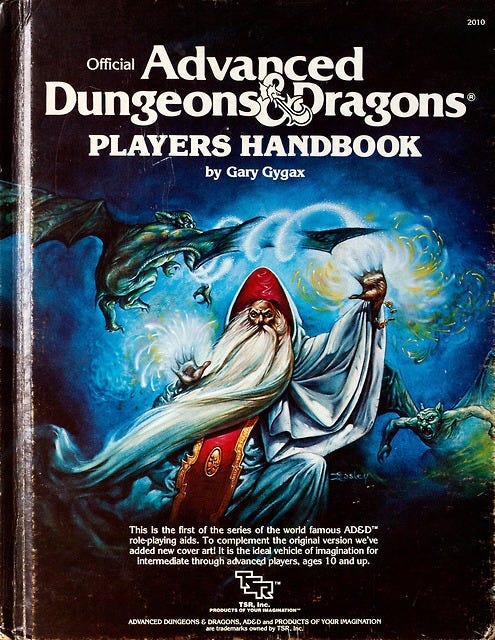
WHAT’S YOUR THAC0, THIFUL? - I spent more time playing with 1st Edition Advanced Dungeons & Dragons than any other. When I think back on my experiences with James, this is the image that invariably pops into my head. I always imagined this as a representation of my elf wizard Thiful whom I repeatedly resurrected, reincarnated, and returned as distant third cousins namesakes player characters. Later on, I paid honor to him by making him the never-seen author of Thiful’s Bird Migrations, one of the most useful skill boosting items in Betrayal at Krondor.
#RPG #DungeonAndDragons #DND #GameDevelopment #GameDev #AdvancedDungeonsANDDragons #ADD #GroceryMan #Stilwell