
The Supernatural 70s
Part III: The Forbidden Tomes

“I saw that the books were hoary and mouldy, and that they included old Morryster’s wild Marvells of Science, the terrible Saducismus Triumphatus of Joseph Glanvill, published in 1681, the shocking Daemonolatreia of Remigius, printed in 1595 at Lyons, and worst of all, the unmentionable Necronomicon of the mad Arab Abdul Alhazred, in Olaus Wormius’ forbidden Latin translation; a book which I had never seen, but of which I had heard monstrous things whispered.”
-- H.P. Lovecraft, “The Festival”
It’s difficult to be a ghoul when you were intended by your parents to be an apostle. I was raised in a time and place where it was not only assumed that I’d be a good little devotee of the church, but it was expected that I’d grow up to be a fervent, Bible-pounding proselytizer of the AMAZING GOOD NEWS!!!! Before I’d ever been a sinful gleam in my father’s eye, my mother frequently attended the crusades of Billy Graham. I’d had the fortune (?) to grow up in Tulsa, Oklahoma which was home to Oral Roberts University, officially making my hometown the crossbar of the buckle of the Bible Belt.
As a kid my childhood routine was strongly ordered. Sunday school and church twice on Sundays. Wednesday night church as well. Bible study and prayers every night before bed. Both of my parents taught Sunday school for the youngest kids in our church, and I was defacto enforcer to keep some of the more “troublesome” kids in line as my parents laid down THE LAW. Frequently too there were cartoons produced by Disney featuring that rat-bastard Jiminey Cricket who was supposed to be our kindly voice of conscious but I’d grow to hate him as the All Seeing, All Controlling monitor of everything I ever did. Come summer time I was riding the bus with the pastor to church every day for Vacation Bible School to ensure that not one single sinful thought ever entered my pre-pubescent mind. But there’s something to be said about trying to tamp down the lid on all that, to make sure every thought is clean, and pure, and in the absolute service of the All Mighty. The more that I was preached to about hell and brimstone and the eternal punishment that was waiting to pounce on my sin-tainted soul, the more interested I became in reading and watching the things that were supposedly lurking out there in the shadows to imperil me. Honestly, it was almost as if they’d wanted me to become a horror fiend. The most paradoxical thing about my intense religious upbringing is that my parents - most particularly my mother - were strangely inconsistent in the ways in which both my older brother and myself were raised. Neither of my parents ever read for pleasure for themselves, but there wasn’t a single night of my childhood when I wasn’t read to sleep until I was old enough to read for myself. By the time I hit elementary school I was already a voracious reader and reading at a grade level far in advance of where other kids my age were. Awards were given out every semester for the student who read the most books and I routinely read more books than the pre-printed certificates even accounted for. Somehow, no one had ever thought a kid my age might blow through more than 25 books in a semester!
Feeding a literary appetite like that wasn’t easy. Being a good boy, I’d read all the wholesome things I was supposed to read beyond my assigned Bible readings. Dick and Jane. The Poky Little Puppy. Clifford the Big Red Dog. Winnie the Pooh. Pippi Longstocking. Frog and Toad are Friends. Bedtime for Frances. Go Dog Go. Curious George. The Richard Scarry Treasury (which while I loved them, I was disappointed that despite the author’s name they weren’t at all scary.) Of course, as I mentioned in part one of this series, I’d snuck in a few juvenile-oriented books with ghost or monster themes to them, but those titles always skidded past my mother’s radar because the supernatural elements within them were little more than window dressing. Casper and Gus were happy, friendly ghosts who were going out of their way trying not to frighten the people they encountered. The terrible creatures of Where the Wild Things Are are easily dismissible as figments of Max’s sleepy imagination. Sometimes I’d also sneak in a few comic books that were supposed to be good for me because they were bible stories or Classics Illustrated. But as the material I was watching and reading became more sophisticated and less about how a child should behave, the less comfortable my parents became.
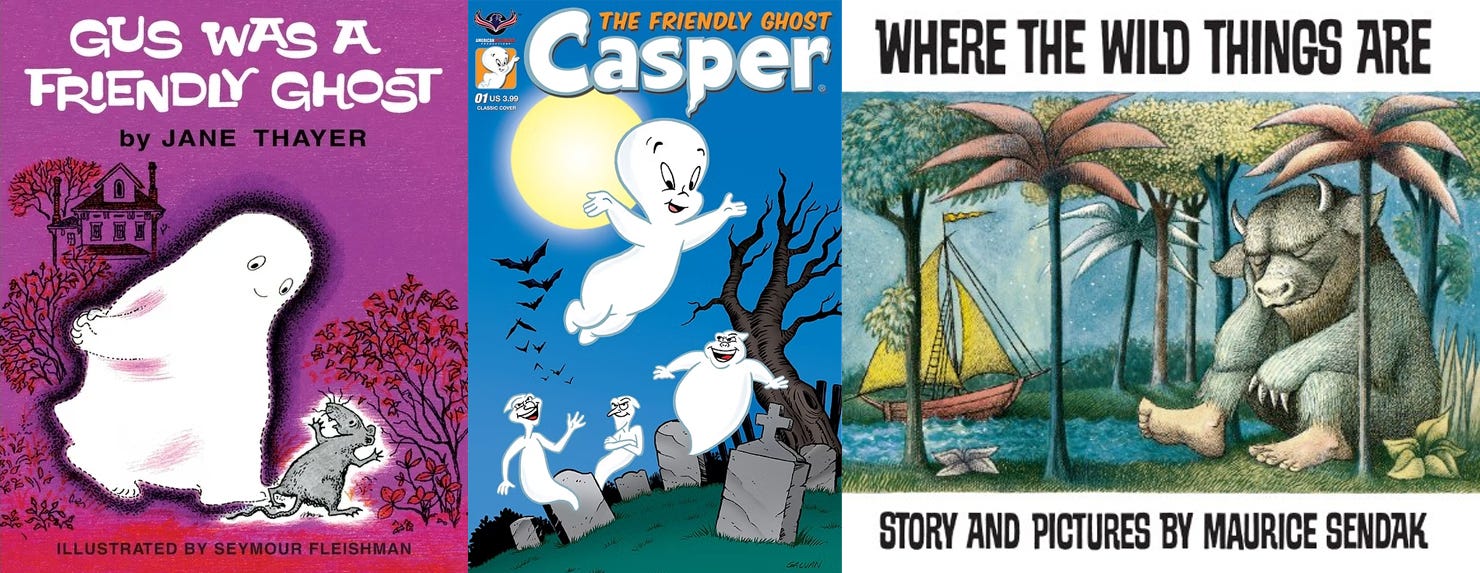
FRIENDLY MONSTERS - My favorite bits of early reading were always laced with monsters and elements of the supernatural. The books about Gus the Ghost were probably my first truly obsessive reads, and I re-read Where the Wild Things Are so many times that my childhood copies literally fell to pieces and I’ve had many copies over the years.
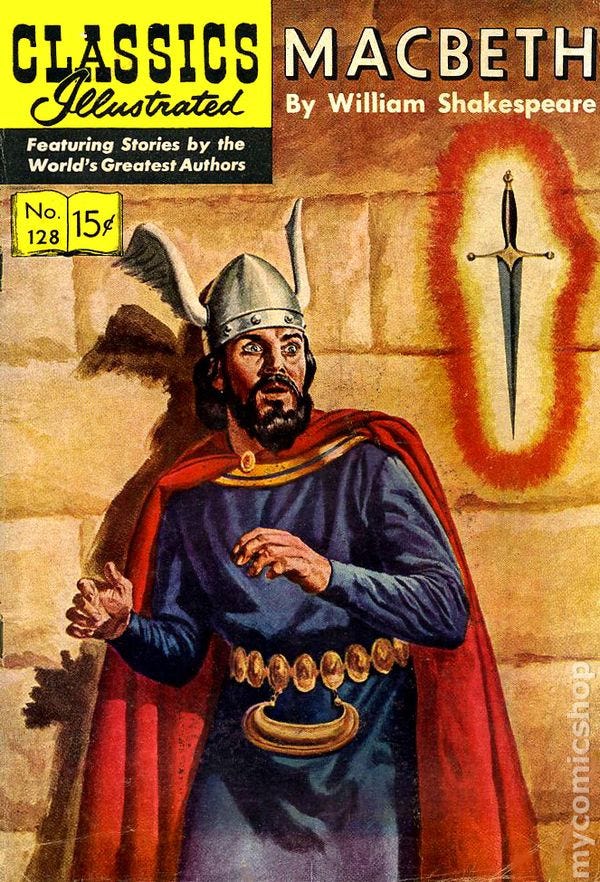
SPOOKY COMICS: Classics Illustrated exposed many children to their first classical works of literature, and I was absolutely hooked on the volumes which covered Shakespeare, particular Macbeth and Hamlet, both of which played heavily with supernatural elements like ghosts, witches, curses, and prophesies.
An important breaking point for my mother’s tolerance would come on October 27 of 1973 with an episode of the Star Trek animated series entitled “The Magicks of Megas-Tu.” Written by Larry Brody, the story followed the crew of the Starship Enterprise as they are caught in a mysterious storm and thrown into an alternate universe where science doesn’t work but magic does.
Aided by a horned man named Lucien who appears on the bridge and repairs the damaged Enterprise, they are advised not to attempt to use magic themselves to avoid attracting attention, but the advice falls on deaf ears and the crew find themselves abducted and transported to a place which resembles the witch-trial era of Salem, Massachusetts. Placed on trial by for acts of witchcraft alongside Lucien, Kirk and crew must square off against the prosecutor, Asmodeus. Spock indicates that there’s a good possibility that Lucien is actually either the Lucifer of Earth’s history, or at least his inspiration, but Kirk points out the witches of Salem had been wrongfully accused, Lucien hasn’t done anything wrong against them and so he defends Lucien against the prosecutor saying that he’d be willing to give his own life in exchange for Lucien to prevent him from being cast out.
The storyline would be a bridge too far for my mother. The idea that Lucifer might have been an alien rather than the devil, or that the hero of my favorite sci-fi TV series was prepared to save him even if wrongfully accused was too much. Even though presented entirely as a fictional scenario, it would set my mother permanently against all sci-fi, fantasy, or horror fiction that drifted into our household. It would cement of pattern of active censorship over genre fiction that had originated because of my brother Gene.
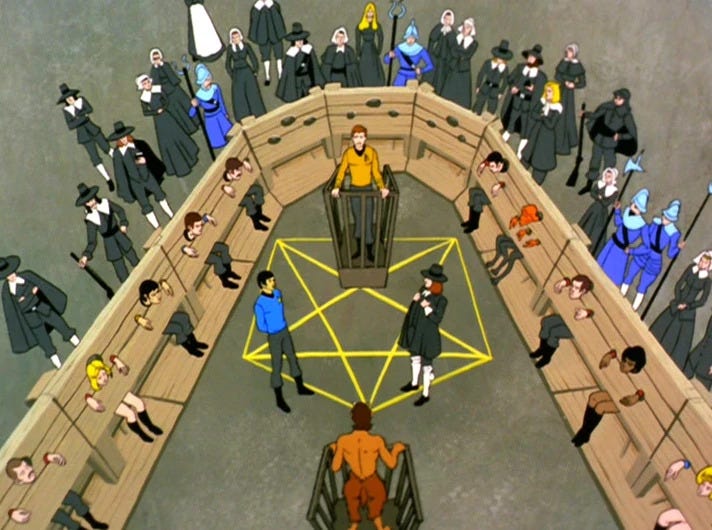
THE MAGICKS OF MEGAS-TU: Kirk defends himself, the rest of the crew, and the magic-wielding alien named Lucien against the Megans in a trial resembling the Salem witch trials. The episode was written by screenwriter Larry Brody who coincidentally also created a series called The Magician that debuted on CBS the same year and starred Bill Bixby.
Much of my taste for science fiction, fantasy, and the paranormal began thanks to the influence of my brother. He had been the one who pioneered the way for me, watching Lost in Space, Star Trek, Twilight Zone, The Time Tunnel and Voyage to the Bottom of the Sea during their original runs, then telling me about them long before I experienced most of them on my own. It was also thanks to him shoving The Hobbit at me in junior high that I ever discovered Tolkien (see Part Four of From Gamer to Game Dev), and also because of him that I first started scribbling down short stories. In so many respects there would never have been a Neal Hallford horror aficionado or game designer if not for his influence over me.
My long trek to the dark side started when Gene tried to check out books about bigfoot and UFOs and ESP from the Tulsa County bookmobile. Today this wouldn’t even raise an eyebrow in most places, but in early 1970s Oklahoma this constituted scandal. Children weren’t supposed to read about that sort of thing. Dire conversations were had with my parents. Pastors were consulted. For this unspeakable crime against humanity, he found himself banned from the bookmobile! But the thing about banning things from kids is, they’re just going to find another way to get to what you don’t want them to have.
In the 70s, there were all kinds of interesting books and comics popping up on magazine stands and in convenience store “spinners.” If you wanted books about space travel, reincarnation, psychic phenomena, vampirism, cannibalism, or the occult, the books were certainly available. Gene was tantalized by all these verboten bits of reading material, but getting the allowance money to buy these things came from our mother, and she wasn’t about to pay for any of this potentially blasphemous trash. Interestingly enough, Gene found an ally in a lady that my family simply called “Aunt Patsy.”
My Aunt Patsy wasn’t actually an aunt, but an elderly 2nd or a 3rd cousin. She and I had a birthday in common, so I have many childhood photos of our shared celebrations. Unfortunately, Patsy was something of an outcast within our family and not terribly well-treated. I seem to remember whispered stories that she’d been a fan dancer or something of the sort when she was younger, but I was very little and I didn’t really understand what all the fuss was about. My father went out of his way to look after her, however, and she was practically a part of my daily life when I was small. Whatever the case may be, whether she was a closet radical, or she simply couldn’t say no to my brother, she would secretly slide him the money when my mother refused to pop for one of Gene’s “suhtonic” books.
Gene amassed a remarkable stash of books which, of course, became the core of my secret lending library as I aged up enough to read them. Ghost stories were my favorite, followed by weird tales of ESP or British stories that fell into the genre that is now known as “folk horror.” But there was one series of books in particular that latched into my brain, and even though in time I’d forget the titles and author names, the covers became indelibly burned into my brain. They all featured exactly the same design. Four illustrated panels on the front covers, and usually two panels on the back. The illustrations were all monochromatic, fantastically lurid line drawings that would have been right at home in the horror comics of the day. Each illustration would have wonderfully evocative captions like “Uncanny Granny’s bedtime tales that come true,” “The incredible dog who predicted his master’s death,” “He returned from the dead to rescue his son,” “His bizarre powers tracked down a hidden killer,” and “Rosemary’s candle is a warning from another world.” Published by Popular Library, they would become the books that would create my love for stories featuring the supernatural.
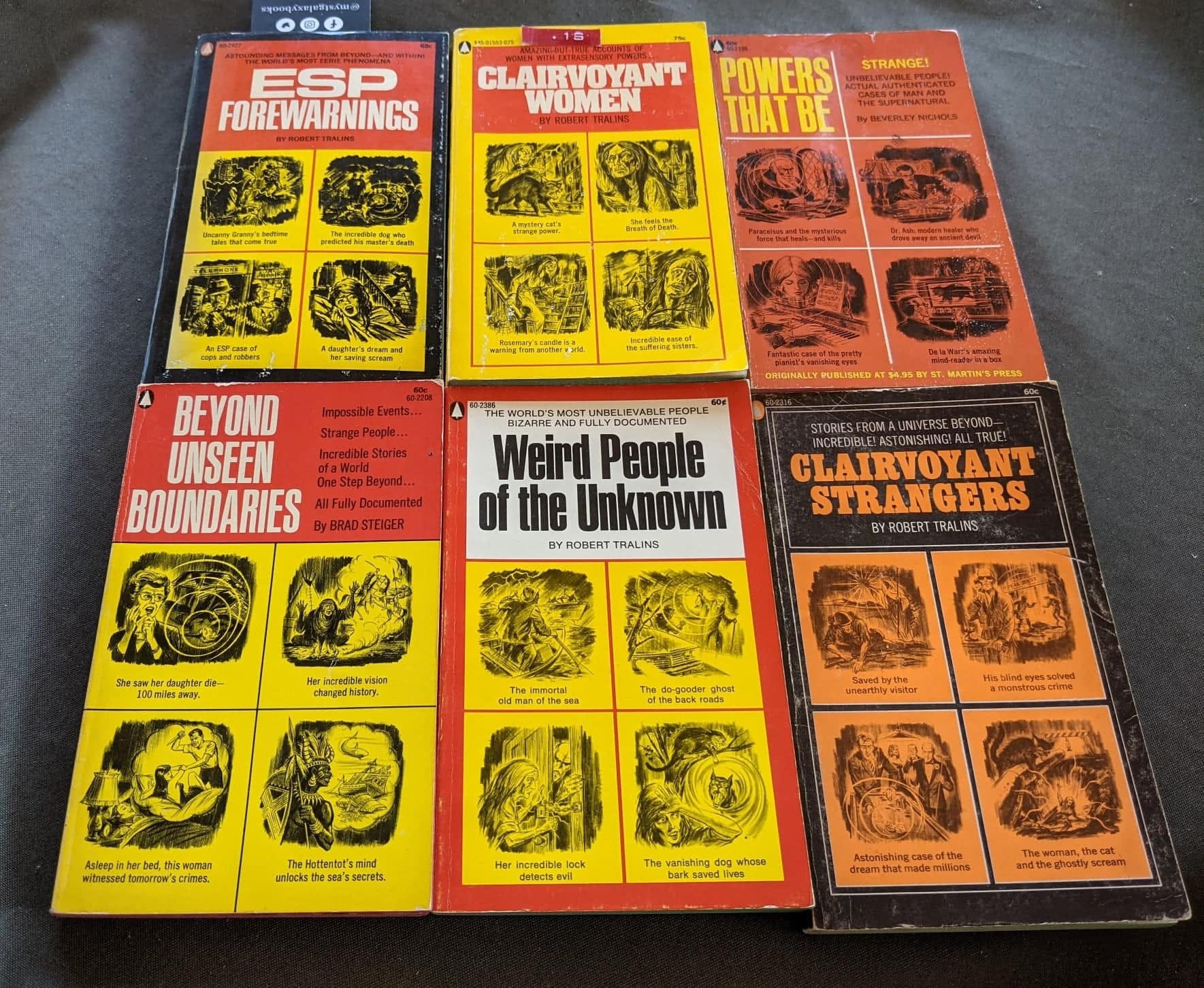
A COLLECTION OF CHILLING HORRORS: My recently reconstructed “Aunt Patsy” collection of Popular Library books about the paranormal. Although I’d forgotten the authors, titles, and publisher, I still remembered the images on the covers and after numerous Google keyword and image searches, I finally was able track these down from multiple sellers. They are ESP Forewarnings by Robert Tralins, Clairvoyant Women by Robert Tralins, Powers That Be by Beverley Nichols, Beyond Unseen Boundaries by Brad Steiger, Weird People of the Unknown by Robert Tralins, and Clairvoyant Strangers by Robert Tralins. (Not pictured is Supernatural Strangers by Robert Tralins).
Another set of books that I loved was a fantastic, illustrated encyclopedia called Man, Myth, and Magic released in 1970 by the Marshall Cavendish Corporation. Compiled from articles in a magazine of the same name, it was a wonderfully comprehensive 26 volume set with loads of photographs, drawings, and diagrams of all things supernatural. It also had articles covering topics which were not in and of themselves supernatural, but were weird or controversial enough to be of potential interest.
At some point during one of her regular Orwellian sweeps of our rooms to look for illicit reading materials, my mother happened upon said encyclopedia and while flipping through it stumbled on a helpful entry about the history of ritual parricide, i.e. the murder of one’s parents. Seeing this, she decided that this one entry out of thousands was advocating the practice, and was quite possibly the reason my brother had purchased all twenty-six volumes. The books were then summarily gathered, removed, burned, and my brother informed and punished ex post facto.
Now, for most families, the book burning would have been the end of the tale, but I didn’t grow up in most families. Before I relate the paradoxical aftermath of this, let me first refer you back to what I mentioned near the start of this post. My parents or my brother read to me to sleep nearly every night as a child. I was raised with a near reverential regard for both books and for reading. Burning a book, regardless of its content, was a cause for deep seated guilt. It simply isn’t done. But my mother had committed this unconscionable act - even in the name of correcting her Satan-deceived son - and she had in some way to make up for this. So what did my mother do? She reached into her purse, pulled out money, and gave him money with the idea that he would, now properly chastened, go out and buy something which would be wholesome and uplifting and lead him back to the Lord. Surprisingly to her, another copy of the encyclopedia would appear in his room shortly thereafter.
This would become a pattern for the remainder of our childhoods.
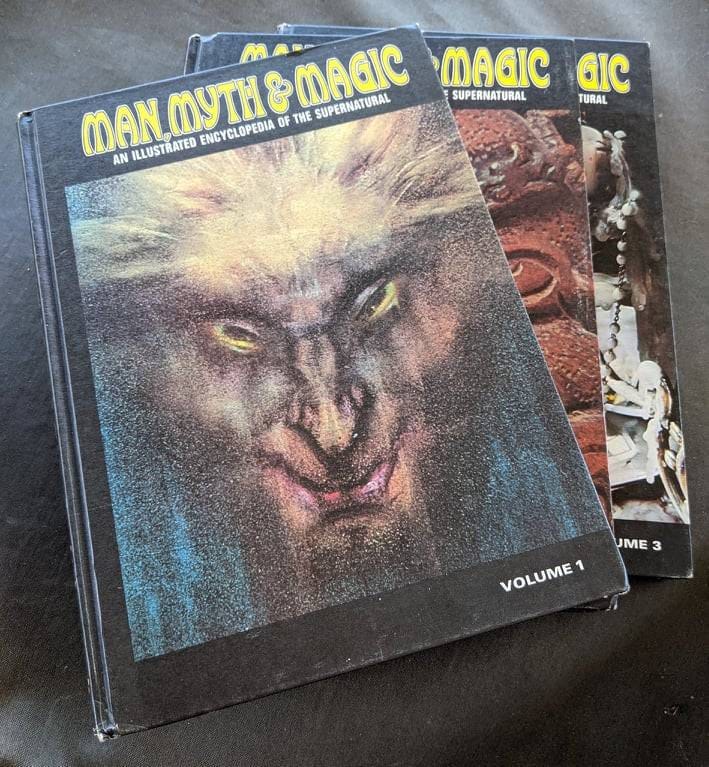
SUBVERSIVE TOMES: The first three volumes of Man, Myth & Magic in my possession (see what I did there) as I began reconstructing the set for my own collection. It is really an excellent reference as well a great time-capsule for views on the supernatural during the sixties and seventies.
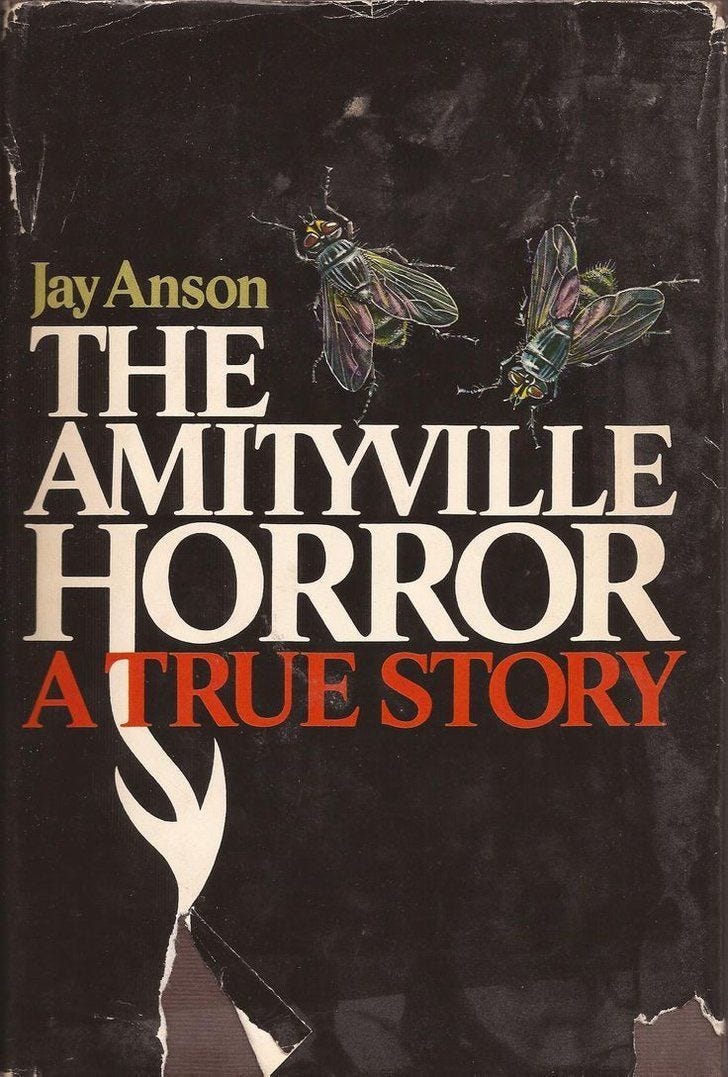
I rhapsodized in Part III of my From Gamer to Game Dev series about my love for the works of both Edgar Allen Poe and H.P. Lovecraft, so I won’t bore you with a lengthy reiteration here about how influential both of these authors were during my early teens. Suffice to say, I fell in love with supernatural horror novels largely thanks to the two of them, but neither of them was writing or publishing in the 1970s in any case — that’s just when I happened to encounter them. But there is one 70s novel that was an absolute rager on the bookselling charts, and one that I remember kids fiercely debating on my school bus. Naturally I had to pick a copy up for myself to see what all the fuss was about. As it turned out, Jay Anson’s The Amityville Horror scared the living hell out of me.
Purportedly based on a true story, Amityville got under my skin because the details felt so relatable. It wasn’t a gothic novel set in a castle, the events didn’t happen a hundred years ago, and even the most overtly supernatural elements were painted in a utterly believable way. But the detail that got me, the one that kept me awake at night related to Jodie, the imaginary friend of the daughter, Missy Lutz. Described as a demonic pig, the book describes a scene in which Jodie’s glowing red eyes are seen looking in the window of Missy’s bedroom — which was not on the ground floor.
Years before ever reading the book, my brother and I had always shared a nightmare about otherworldly eyes looking into his bedroom window, a window that 12 feet above the ground of our back yard. A window that still gives me shivers to look out of at nighttime when I’m in my childhood home.
Goodnight kids!
#horror #supernatural #novels #occult #70s #PopularLibrary #StarTrek
I love the ending, Good Night Kids!
Its so strange to see how people were back then about God vs now. My stepmother is a lot like that now. I went to VBS too. Church TWICE a day Sundays? I LOVED the bookmobile, to be banned from it would be death to me at that age. Burning a book is also considered Big Serious in my family too. Star Trek and the Salem witch trials would be satanic coded to my stepmother too. I dont know how people like that can find fun in church and doing nothing else with their imaginations, no disrespect. Its just wild.