
The Supernatural 70s
Part IV: Flickering Phantoms

There was a thing in our basement.
It crouched in shadows, waited until the skies turned black and the winds howled and the windows shook, waited until we had no choice but to descend the steps and keep the wretched thing company. Once we gathered, it would open a single, unblinking eye on us, and it would begin a recitation of town names, and trailer parks, and intersections, places which once had been but now no longer were, places forevermore erased from the face of earth. And so for hours there my family would sit, entranced by our cyclopean demon, fervently hoping that its next apocalyptical pronouncement would not include anything about us.
If you haven’t lived in America’s so-called “tornado alley,” you might not fully appreciate that a television set occupies a special place in the lives of alley-folk. Beyond being a source of entertainment to us, or a window on current world events, a television served as a safety device. It told us where the tornadic storms were, where they were going, and whether or not we should get Fluffy out of the yard. It also served as an anxiety dispenser as we watched the tornadoes pass by - or more frequently through - the places where our friends and loved ones lived. Given this, you can understand why so many of us wanted televisions in our basements. We needed something to watch while we were huddling down there in the dark and hoping not to die. Furthermore, with TV, we had a pretty good idea when it was safe to come out of our hidey-holes.
Of course, one of the big problems with using a TV for this purpose was power. During a tornado, it was always possible that the electricity would get knocked out by high winds or lightning strikes. Battery-powered radios were certainly an option, but nothing beat being able to see on radar exactly where the action was going down. Thankfully, for those of us who had to deal with this quandary, Sears popped up in the mid 1970s with a portable, (seemingly ten-thousand pound), 13 inch, battery-powered television set that would allow us to stay on top of the news even when the power went out. Being the safety-conscious woman that she was, my mother dutifully bought one of these believing that we could keep it in the basement for emergencies. I, however, had other plans.
Like most children my age, I didn’t have a television in my room. Beyond the fact that such things would have been considered irresponsibly extravagant back in the day, the prevailing wisdom of the time was that TV was bad for children. It disrupted our sleep patterns. It gave us nightmares. It led to bed-wetting, anti-social tendencies, communist sympathies, and probably Satan worship. When added to the fact that I, like my mother, was a nocturnal creature with insomniac tendencies, the last thing my parents wanted to do was put a TV in my room. But the devil of the thing was, it proved almost immediately to be an effective mobile babysitter for me. When we made long distance trips out of town, my parents didn’t have to make special arrangements anymore so that I could watch Night Gallery or Star Trek. When my mother taught night school for adults or later at the Salvation Army unwed mother’s home, it was easy enough to park me in a nearby room with a pair of headphones to keep me distracted. So when I began to start keeping the portable TV in my bedroom at night so I could watch late night horror movies, my battle had already been won.
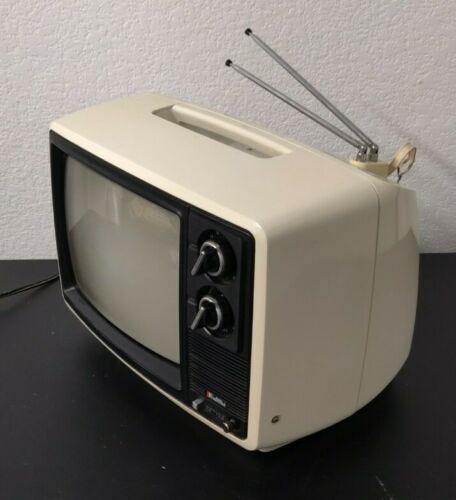
DON’T ADJUST YOUR TV - A Sears 13” portable television similar to the one my family bought in the late 1970s (ours was brown, and only displayed black and white). Not only did this become my gateway to fantastic television, but it would also become the monitor I used to connect my Atari 400, my first writing tool along with being my first computer gaming platform.
In addition to all of the Universal horror flicks from the 1920s-1950s that I already loved, my illicit little TV introduced me to the heavily Bowdlerized 1960s versions of Dracula, Frankenstein, and The Mummy presented by the greatest house of horror ever, Hammer Films. I would also discover the magnificent cycle of Poe films made for American International which enshrined a new triumvirate of terror formed by Christopher Lee, Peter Cushing, and Vincent Price. But above all else, it was a movie made in 1970 that I would discover during an “afternoon movie” on Tulsa’s KOKI that would become one of my favorite horror movies.
I can’t honestly count the number of times that I’ve watched The Abominable Doctor Phibes. Before the advent of home video, I made sure I caught every airing of it on TV, and if it ran in the film room at a local convention, I’d drop everything to make sure I was there to watch, regardless of the hour. I’m fairly certain I squealed out loud with joy the first time I found it on video cassette, and I’ve owned a version of it (and its sequel) in practically every medium in which it has appeared since.
Starring Vincent Price at his most malevolent but velvety-voiced best, Doctor Phibes follows the story of a hideously disfigured genius hell-bent on avenging himself on the doctors who failed to save his dead wife. Aided by his gorgeous assistant Vulnavia, he uses the ten biblical plagues as inspiration as he offs his victims one-by-one with a stylish sense of aplomb, all between performing private pipe organ recitals inside an art deco tomb. If you’ve never seen it, you’ve missed one of the most gloriously bonkers, over-the-top horror feasts of all time.
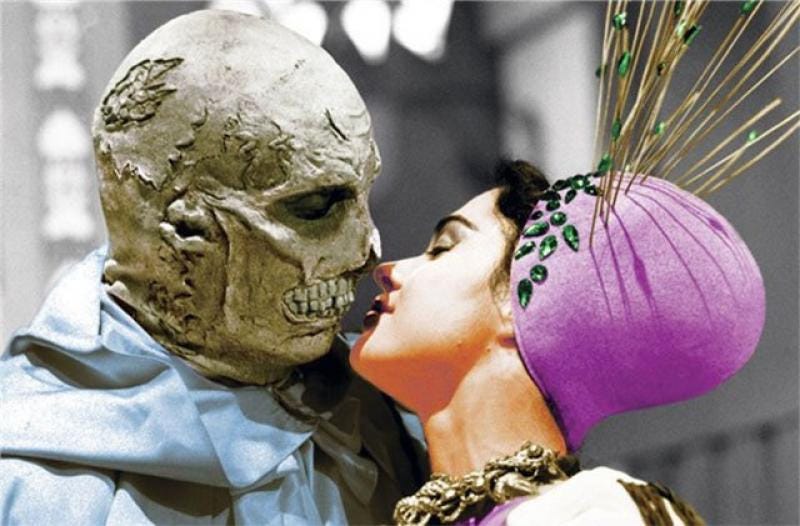
SWEET VULNAVIA: The Abominable Dr. Phibes is a deliciously fun cult favorite, and altogether one of the most stylish horror movies ever created.
Our portable TV became a frequent co-traveler with me as we took long trips to visit various relatives scattered across the state of Oklahoma. Most frequently I had it with me when we headed down to my grandparents’ farm south of Haskell. Their home was an old, creaky homestead situated on a hundred acre plot of land in the middle of nowhere, accessible at the time only by long, desolate stretches of gravel road. Without the TV it was easy to feel isolated on the trips back home. The world outside our station wagon was often pitch black, with nothing visible but dark clumps of trees that crowded too closely to the road. Sometimes things would appear in our headlights, appearing and disappearing before we could ever clearly identify what they were. I didn’t like to think about what might be lurking unseen just outside of our view, what might be watching us from the shadows. These fears would be greatly amplified and played upon by the next movie in my list.
In November of 1972, The New CBS Tuesday Night Movies presented what was easily one of the most traumatizing horror films of my young life, namely the made-for-TV movie, Gargoyles. Starring Cornel Wilde and Jennifer Salt (later of TV’s Soap fame), the story follows the research trip of Dr. Boley and his daughter as they travel through New Mexico to a roadside attraction, Uncle Willie’s Desert Museum. Uncle Willie (played by Woody Chambliss) has invited Dr. Boley to see something he’s got hidden in his shed that he doesn’t show to all his tourists, namely the skeleton of an ancient gargoyle! As Willie unspools the ancient Indian legends about the creatures for his visitor, the shed is suddenly attacked, the building catches fire, and Willie is killed in the chaos.
Fleeing the burning building, Dr. Boley and his daughter leap into their station wagon and head off down the road. Confused and horrified by what’s just happened, they decide to play back the recording of Uncle Willie’s tale in the hopes of figuring out what the hell is going on. No sooner than the tape gets rolling, however, their station wagon is beset by a flying gargoyle. Landing on the roof, it attempts to claw itself inside while Boley steers wildly to try to shake it off, eventually ditching the creature in the weeds. (It is thanks to this scene that being in a car in the middle of the night on a gravel road still gives me the heebie jeebies!)
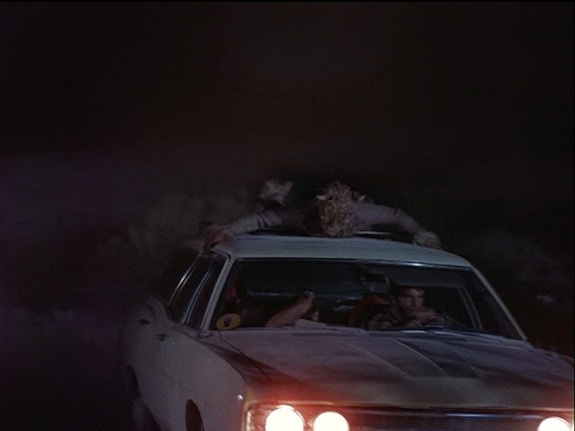
WE’VE BEEN TRYING TO REACH YOU ABOUT YOUR CAR WARRANTY: Although it was a made-for-TV movie with a relatively low budget, Gargoyles featured some truly outstanding creature effects created by the legendary Stan Winston. The lead gargoyle was brilliantly portrayed by actor and former football star, Bernie Casey, best known previously for his role as Blackula.
The terror of the open road that Gargoyles inspired in me as a child was not something that afflicted my father. If anything, he likely would have spent all his time behind the wheel of a car on his way to god-knows-where if he hadn’t had a wife and two kids to support. Because both of my parents were teachers and had the summers off, we had the luxury of taking a long road-trip every summer. In most cases we didn’t even know where our father was taking us when we got started, but only that we should expect to be on the road for a long time and be prepared for practically any contingency. This meant that we kicked off every trip with a silver, coffin-sized ice chest that extended the entire width of the station wagon that was stuffed full of Oscar Meyer hot dogs, bologna, American cheese, Miracle Whip, mustard, milk, a couple of loaves of Rainbow bread, and a box each of Twinkies and Ding Dongs. On a split second notice we’d be tumbled out of our beds at dawn with our noses pointed toward Destination Anywhere.
This devil-may-care attitude of my father in regard to our travel plans meant that we often ended up in peculiar circumstances. On more than one occasion I can recall driving through storm systems that were spawning tornados in front of or behind us, and spending some nerve-wracked evenings in motels that lacked convenient storm shelters. More than once we slept in rest stops when we discovered that the towns where we’d been anticipating pulling in for the night had no vacancies. Or even motels. In the age before car navigation systems we often ended up lost because of my father’s predilection for “short cuts.” On one particularly memorable night at about three o’clock in the morning while rolling down a single-lane road in Colorado, we were startled by a sudden Close Encounters-like light that erupted in the middle of the road in front of us. Men with guns appeared at our car windows and we were coolly informed that we’d found the secret entrance to an air force facility, and we needed to turn around and go back to wherever we’d come from in a hurry.
When Race With the Devil starring Peter Fonda was released in 1975, I felt almost as if someone had been spying on our family experiences for inspiration. Combining an accidental encounter with Satan-worshippers while on a road trip in a Winnebago, Race is quite possibly the most 70s horror movie ever conceived. Camping and road trips were all the rage in the early to mid 70s, and Winnebagos were one of the most lusted after commodities of bored suburban dads (I spent more than a little time haunting car lots in Tulsa with my father as he drooled over these automotive beasts.) The 70s were also the golden age of cinematic car chases, so mixing all of these elements together had to have been a no-brainer for the movie’s producers. It would become the movie that made you too terrified to take a break at a deserted rest stop ever again.
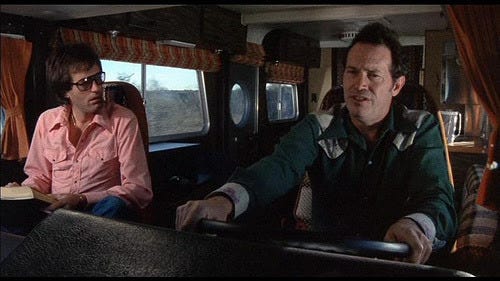
HELL ON FOUR WHEELS: Peter Fonda co-starred with the always amazing Warren Oats in this non-stop action thriller from 20th Century Fox.
Wiccans were a recurrent target of the horror movies of the 1970s, and their beliefs and practices often were wildly distorted in order to cast them in the role of evil, devil-worshipping, murder-minded villains. These films as a whole perpetuated harmful myths about a largely marginalized community, and I can say from personal experience that the vast majority of the self-proclaimed witches that I’ve ever met have been kind, nature-loving peaceniks who bear no resemblance whatsoever to the cauldron-stirring variety found on film. That said, if we view the witches of cinema as wholly made up monsters rather than representatives of any real world religious community, there are some exceptionally good witchy horrors that came out of the era.
Crowhaven Farm is quite possibly one of the best of the bunch, rising far above the rest with a well-crafted story that elevated it above its cohort. Diving into the familiar waters of clandestine conspiracies, mysterious pregnancies, and creepy children, it also touched on another paranormal subject about which many other filmmakers became obsessed during the supernatural 70s, namely reincarnation.
Released originally in 1970, Crowhaven Farm popped up periodically in reruns and originally caught my attention during a late night showing because, for whatever reason, I conflated the star Hope Lange with Bewitched star Elizabeth Montgomery (in retrospect I’m not sure how I made this mistake, aside from the fact that they were both pretty blonde housewives in shows about witches.) In Crowhaven, Lange and her husband move into an old house in the country, but shortly thereafter she begins to be haunted with nightmares of being crushed to death during the Salem Witch Trials, dreams which she will soon learn are not dreams at all but memories of her previous life as the condemned witch “Meg” Carey. Filled with several twisty plot turns, this sophisticated suspensefest feels like something bigger than the made-for-TV movie that it was.
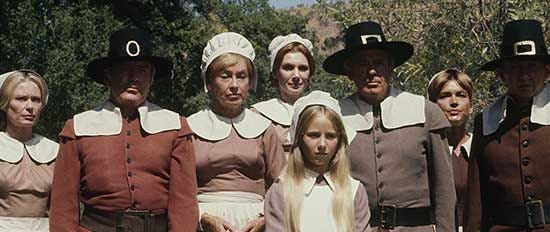
CRUSHING EVIL: The puritans gather to stone “Meg” Carey to death for witchcraft in one of Lange’s memories of her past life in Salem. Prior to her role in Crowhaven, Lange starred in a short-lived TV series adaptation of The Ghost and Mrs. Muir.
Another common supernatural fixation of the 1970s had to do with the body of water found between the southern tip of Florida, the island of Bermuda to the east, and the island of Puerto Rico in the south. Commonly known as the Bermuda Triangle, this region has a long history of mysterious nautical legends ranging from missing ships, missing airplanes, strange fogs, electromagnetic disturbances, UFO sightings, and all sorts of other weird phenomena. Stories about it made regular rounds in newspapers, news programs, and in documentaries all through the decade. For me, however, that region of the Atlantic Ocean is fixed forever in my imagination thanks to the chilling ABC horror thriller, Satan’s Triangle.
Released in 1975, Satan’s Triangle kicks off with a pair of Coast Guard pilots being called in to rescue a stranded boat. Once there, they discover a priest hanging dead by his ankles from the main mast, another man dead in the forward hatch, another seemingly floating in mid-air below decks, and the only survivor a terrified but speechless woman hiding in a darkened cabin. After the initial attempt to rescue her fails because of an accident, one of the rescuers is forced to remain on board with the woman as she begins to recount the eerie events that left her the only personal alive aboard the drifting vessel. Even as rescue finally does arrive for them both, however, a final twist reveals that nothing is what it appears to be.
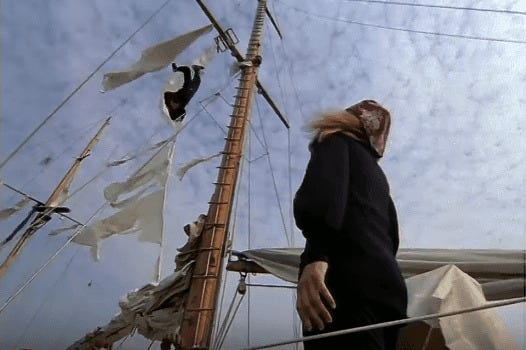
LET’S GO SAILIN’ WITH SATAN: Kim Novak and Doug McClure star in this taut little supernatural thriller from director Sutton Roley. As with Crowhaven Farm, over the years my mind played strange tricks on me, and until I was able to later re-watch it in the 2000s, I was thoroughly convinced that Roddy McDowell had been in the cast (spoiler: he wasn’t.) Combining elements of the Flying Dutchmen with various legends about the Bermuda Triangle, this remains one of my favorite sea-bound horrors.
In the very same year that Doug McClure was making the biggest mistake of his Coast Guard career in Satan’s Triangle, one of my all-time favorite horror heroes took his first bow. Kolchak: The Night Stalker starring Darren McGavin followed the adventures of intrepid newspaper reporter Carl Kolchak as he tried to stop, or at least report on, the innumerable supernatural horrors that plagued the cruel streets of Chicago. During his brief tenure on TV he faced down vampires, demons, dream monsters, zombies, Aztec mummies, living suits of armor, and a whole host of other menacing monsters. Inspired by these adventures, television producer Chris Carter would later go on to create the X-Files which bore an incredible debt to The Night Stalker. Carter would even go so far as to introduce a character played by Darren McGavin as the originator of the FBI’s X-Files, giving the fans an in-universe meta-acknowledgement that Mulder and Scully had Carl Kolchak to thank for their start.
What I loved about Carl, and what I know others connected with as well, is that Carl wasn’t a slick, well-respected reporter. He worked for a boss who didn’t respect him, and didn’t believe any of the bizarre stories that Kolchak brought to the paper. But Carl had street-savvy, and he knew his way around the the rejects of his community. He was frequently broke. More often than not he bungled his way to success, but he always got his story regardless of whether he could convince his editor to print the truth. In so many ways he mirrored other television detectives of his era like Peter Falk’s Columbo and James Garner’s Rockford, loveable oddballs all that we were rooting for because we could see ourselves in them. This identification was especially important to me because he arrived around the time that I was beginning to think about my future career as a writer, and the evocative idea of a monster-hunting reporter took a firm hold of my imagination.
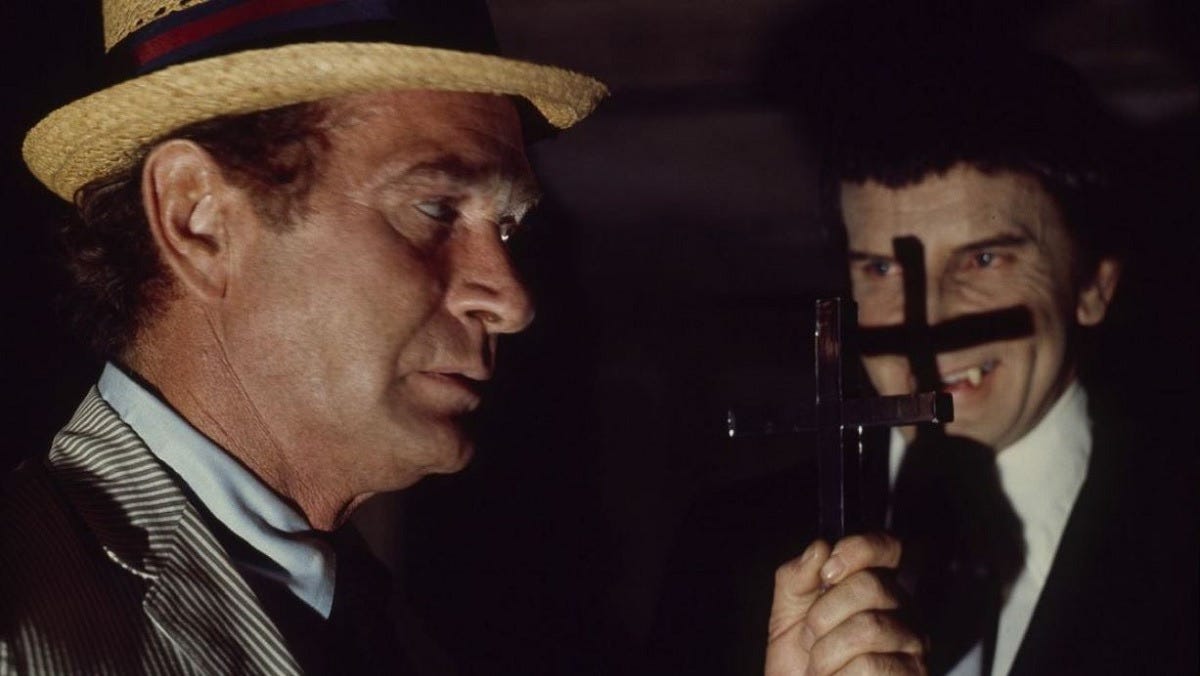
LISTEN TO ME, TONY: Although Kolchak: The Night Stalker only ran for one season, it became a cult hit and would go on to influence several other horror programs, most notably Chris Carter’s X-Files.
For the bulk of the 1970s, I discovered horror movies thanks to their appearance on late night or afternoon movie programs available through my trusty portable TV. Most of those films would be made-for-TV productions like those I’ve listed above. For this reason I missed the original theatrical runs of important movies like The Exorcist, The Omen, The Town That Dreaded Sundown, The Texas Chainsaw Massacre, and The Amityville Horror. I would discover these classics only years later when I was able to rent them on VHS away from the disapproval of my parents. My long isolation from horror on the big screen would at last come to a screaming end with the arrival of 1978’s The Manitou.
To be honest, I don’t really recall much about the movie. I’ve only ever seen it one time, but I do remember being seriously freaked out about its weird combination of reincarnation, self-aware tumors, and Native American spiritualism. I’m not even sure I really got it all at the time, but it was nothing at all like the relatively genteel horror flicks I’d remembered watching at home on my tiny screen. But however good or bad it might have been, it represented one of my first steps towards adulthood.
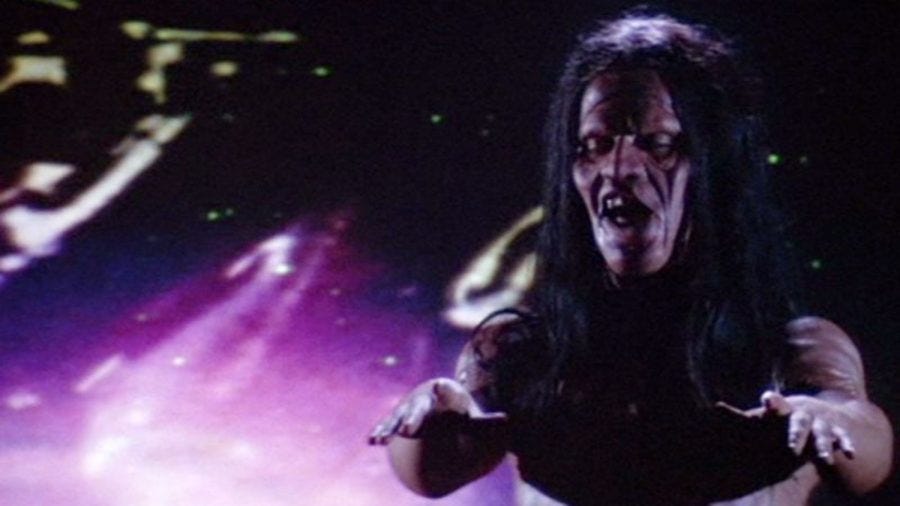
WHAT THE HELL DID I JUST WATCH: The Manitou was a deeply messed up movie based on a book of the same name by horror writer Graham Masterson. I do not recommend viewing it if you are at all bothered by any lumps, bumps, or growths that you have on your body.
#Supernatural #70s #Witchcraft #Reincarnation #BermudaTriangle #Movies
I can tell youre trying to write these before/during the time of Halloween!
Creepy stuff!
I would have been SO SCARED about the air force base thing. Your casual aside about your dad taking a shortcut and finding himself flanked by the military was, oddly enough, the scariest thing about all of it!
Thank you for the chills!