
The Supernatural 70s
Part V: Inquisitions

“When you have eliminated the impossible, whatever remains, however improbable, must be the truth.”
-- Arthur Conan Doyle, The Case-Book of Sherlock Holmes
Today, if you drive down 15th street in Tulsa between Peoria and Utica, you’ll find a stretch of trendy pubs, coffee houses, clubs, and galleries (along with a handful of Tulsa’s oldest churches.) Revitalized in the mid 1980s and re-christened Cherry Street after its original, pre-1907 name, the Cherry Street District is a hot spot for young folks to find food, fun, and largely harmless entertainment. If you were to wind the clock back to the pre-disco era however, you would discover a neighborhood that was quite different.
In the 1970s, 15th Street was considered quite unsavory by mainstream Tulsa’s standards. Most of the businesses along it were operating out of run-down storefronts, and the low rents in the community typically attracted more drunks, drug addicts, and vagrants than it did shoppers for its string of beauty shops and junk stores. Unattractive as it could seem to more traditional, middle-class folks however, it also became a haven for Oklahoma’s outcast hippies, heretics, hookers, queers, commies, witches and other miscellaneous counterculture warriors. Predominantly the talk on the street there was not about commerce but about altered states of consciousness, spiritual awakenings, and new social orders.
Founded in 1975, Peace of Mind Books became a gathering place for all those searching souls on 15th Street. Stepping into the front door, visitors would be met with a mélange of competing smells: old books, sandalwood smoke, patolli oil, and the unmistakable reek of Muskogee weed that couldn’t be concealed, regardless of what they put in their incense burners (I hate to break it to you folks, but Merle Haggard had no idea what they were smoking down there.) Crystals hung in all the storefront windows, splashing rainbow-colored light across the spines of countless books covering everything from Carlos Casteneda’s musings on anthropology, tomes of Celtic history, Foxfire books about getting back to nature, beat poetry, gay fiction, Elizabeth Clare Prophet’s angel books, and that burgeoning category that was increasingly becoming associated with Peace of Mind, the occult.
Now as we’ve already discussed in this series (and elsewhere in this blog), during the early and mid 70s, I wasn’t quite ready for what Peace of Mind had to offer. I was still very much a church kid. Until my brother Gene suggested one day that I come with him to check the place out, I’d never even thought of stepping across the threshold of such a heathenish establishment. Even if it wasn’t for the heretical books that were darkly rumored to be on the bookshelves, they also had a massage parlor attached to the bookstore, and I knew about those places. Well, at least I’d heard about them on the TV news. The last thing I wanted was to do was get arrested for going to a bookstore. But finally, after a little convincing that I wasn’t going to get in trouble, he talked me into it, just like he did everything else.
As we walked in from the parking lot, I was filled with dread that I’d find Anton LaVey sitting behind the counter eating a baby, but the shop was not at all what I’d expected it to be. It was as I described above, a cozy little bookshop that admittedly smelled a little funny, but I was too young at the time to recognize “that smell.” As for our clerk, it wasn’t Anton, but a rather sweet, mousey-looking twenty something year old girl who was thumbing through a book about horoscopes. She asked me my star sign, because that was also a thing about the supernatural 70s. Everybody knew their star signs and talked about them vociferously, even if they didn’t believe in them.
What I’d come looking for, despite my early reservations about the store, was a book about the watchers (aka Nephilim) who were mentioned in Genesis 6:4 of my King James Bible. “There were giants in the earth in those days; and also after that, when the sons of God came among the daughters of men, and they bare children to them, the same became mighty men which were of old, men of renown.” I had of late become obsessed with this little bit of biblical lore. I had many questions. Sons of God? Plural? Were these angels, or something else? And giants created by angels having sex with humans? The more I’d begun to dig, and to ask questions from my bemused youth pastor at church, I found only more questions which my protestant friends couldn’t comfortably answer. When they didn’t want to discuss the conflict between the idea of a perfect and unchangeable heaven and the idea of a war in heaven (which is discussed in greater detail in the Catholic bible, and even more in the gnostic gospels), I started to look for answers on my own. I was getting kicked out of churches all across my hometown because asking questions was not welcome. But here, in this quiet little store on 15th street, I found other people like me who were just trying to make sense of the stories they’d been told growing up, make sense of the world that in the 1970s seemed to be positively aboil with paranormal activity.
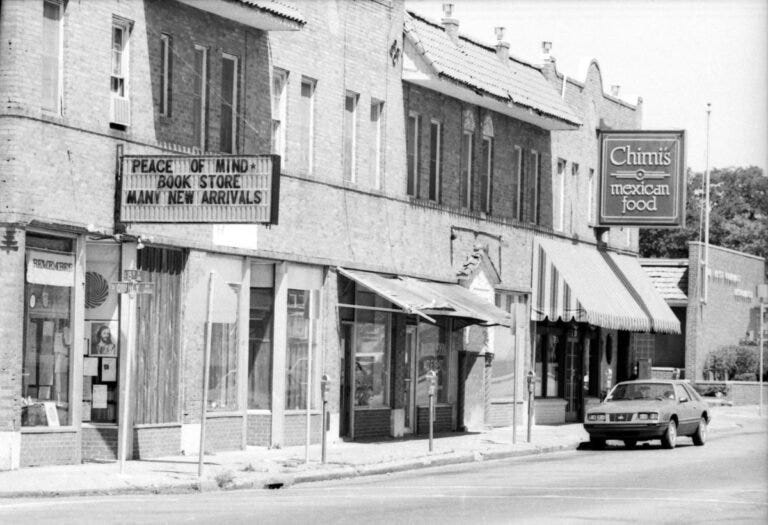
DO YOU WANT A HAPPY ENDING? Just what every teenager wants. A spiritual bookstore on the corner, and a massage parlor just up the stairs. I guess everyone has to find their own way to spiritual relief.
I think my trouble probably began with Johnny Carson. Many years before I ever set foot in Peace of Mind Books — long before Jimmy Fallon or Jay Leno began warming the throne vacated by the once great king of late-night television — Carson wielded the kind of cultural relevance that teenage Tiktokers only dream of ever having. The thing about most people having only three channels of television to choose from is that even the lowest rated program of that era would be a run-away ratings hit for any show on any linear network or streaming channel today. Positively every American who had a TV set watched Johnny at least a few times a week, and whether he was interviewing Robin Williams for the dozenth time, or poking fun at Ed Macmahon, or cracking himself up doing his corny Carnac the Magnificent mind-reader routine, Carson focused the national attention on whatever he was interested in at the time. Virtually everyone he anointed with an appearance became an overnight celebrity regardless of what their statuses had been the night before they sat on his star-making couch.
I don’t know for certain what Johnny’s true thoughts were on the subjects of things like the paranormal, but it was through his show that I first heard adult people at least semi-seriously discussing topics like extra-sensory perception, telekinesis, faith healing and spontaneous combustion. The mind reading mentalist Kreskin made a stunning eighty-eight appearances on The Tonight Show over the years, while notable paranormal skeptic The Amazing Randi — who for many years offered a million-dollar reward for incontrovertible, scientific proof of psychic phenomena — made an astonishing thirty appearances on Carson himself. Admittedly, it’s a chicken and the egg discussion about whether Johnny was helping drive the national conversation about these ideas, or whether he was simply responding to the zeitgeist of 70s America, but clearly everyone at the time was interested in exploring what lay in the grey area between the worlds of faith and of science.
For myself, I think a major moment came on the night of August 1, 1973 when I was watching The Tonight Show with my parents, as I so often did. One of Carson’s announced guests for the night was someone I’d never heard of, a nobody psychic by the name of Uri Geller. During his appearance Geller was supposed to try to bend a spoon using psychic energy, but the demonstration (aided by fellow guest Ricardo Montalban) was — let’s be perfectly frank — underwhelming. The extremely close camera work ensured that Geller couldn’t simply use sleight of hand to swap the unbent spoon in Montalban’s hand for an altered one. At the end of it, the spoon seemed to have a barely perceptible bend it that the guests all claimed hadn’t been there before, but it was hardly a show-stopping demonstration. While Carson, Montalban and Macmahon all politely tried to hide their disappointment, Geller became defensive. He blamed bad vibes, accused Carson and the audience from putting too much pressure on him that drained him of his metaphysical “strength”. Carson tried to apologize and reassured his guest that he believed in him.
Regardless of how much that spoon did (or did not) actually bend, I was struck by the fact that here were four well-known, supposedly reputable grownups, talking seriously and credulously about psychic phenomena on national television. By Carson seeming to take this idea seriously, I felt as though I (and the rest of the audience) were being given permission to believe that such things might be possible and were worthy of investigation.
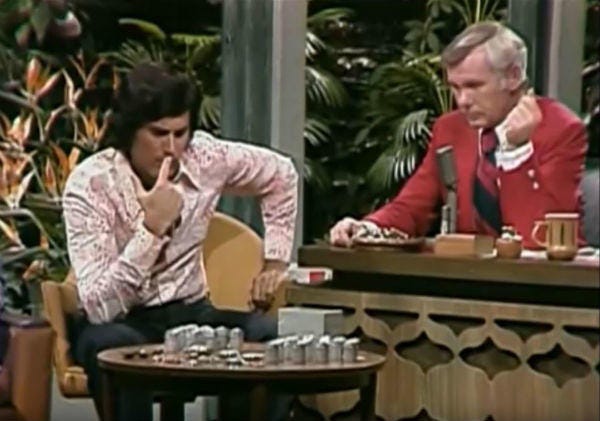
GOIN’ ON A (SPOON) BENDER - Despite his poor performance on Carson, Geller soon became the poster child of psychic experiments in ESP and telekinesis, and regularly turned up on talk shows and programs devoted to psychic phenomenon throughout the 70s. Though several associations of stage magicians have denounced him as a fraud over the years, Geller maintains that he possesses real powers.
In 1974, a year after Geller’s evident psychic “misfire” on The Tonight Show, an announcement about an agreement between Egypt’s President Anwar Sadat and U.S. President Richard Nixon would fire imaginations all across America. Following a successful tour through England, a travelling show of Pharaoh Tutankhamun’s tomb goods — Treasures of Tutankhamun — would come to the United States so that every Bob, Dick, and Harry could lay their eyes on the glory of King Tut’s gold-plated sarcophagus. It would become one of the biggest and most defining cultural events of the decade.
Even before the tour could arrive in America however, everyone and their Anubis-cosplaying dog was looking for opportunities to cash in on the rising wave of Egyptomania. Not since Howard Carter’s discovery of the boy king’s treasures in 1922 had there been such tremendous interest in anything to do with the land of the Nile. Almost immediately busts of Tut, and Nefertiti statuettes, and ankhs, and cartouche necklaces, and posters of the Valley of the Kings started turning up in the most backwater gift shops far, far away from any place the tour would actually ever visit. Comedian Steve Martin would later turn this new-fangled American fascination into the chart-topping hit “King Tut” in 1978. A hasty revival of Egyptologist E.A. Wallis Budge’s The Egyptian Book of the Dead — crammed to overflowing with 19th century translations of classical Egyptian hieroglyphic texts — started popping up at mass market booksellers like B. Daltons and Waldenbooks as recommended reading for those seeking the esoteric, lost knowledge of the Egyptians — so naturally, Gene brought a copy home for me to read. This bizarre magic-tinged world of animal-headed, self-birthing gods arrived at just the perfect time to feed into the supernatural frenzy of the 1970s.
My own personal encounter with Egyptian-flavored new age mysticism was through the book Pyramid Power published in 1974 by Max Toth and Greg Nielsen. The front cover of the book was adorned with a pyramid radiating lines of power, and was irresistibly captioned: the secret energy of the ancients revealed…the great mystery! (How could I — as a self-respecting eight-year-old scientific peer — possibly refuse the opportunity to learn the secrets of the ancients?!) The central thesis of this weighty tome of wisdom was that the pyramids weren’t just buildings, but actually huge psychic batteries that collected metaphysical energy that would preserve any organic material contained within them. It wasn’t that the pyramids housed special machinery to accomplish this feat or even that they were created out of any special materials (I mean seriously, there weren’t even any tana leaves involved? Kharis is disappointed in you Messrs. Toth and Nielsen!) Just the simple fact that the pyramids were, well, pyramid shaped was evidently all that it took to harness this theoretical power.
This idea of objects serving as psychic batteries wasn’t original to Pyramid Power. It was actually a topic that was being hotly discussed in the 70s by metaphysics bros largely thanks to the publication of a book published in 1968 by Erich von Däniken…but we’ll get to him and the chief subject of his book shortly. If you want to wander even further back, you can go down the rabbit hole of Plato’s perfect solids and the alchemical associations they were given during the Middle Ages…but we digress.
Beyond talking about the Egyptian pyramids, Toth and Nielsen suggested that if one sat inside a pyramid, one could attain greater longevity, reduce blood-pressure, achieve greater mental focus, enjoy greater sexual pleasure, receive spiritual insights, and generally achieve higher states of consciousness — you know, the same kit and kaboodle of stuff that all the 70s health and wellness bros were promising — if only you were willing to exercise, eat granola, and give up every other single food you ever loved.
Being that I wanted all the benefits that were promised by the book, I decided to test their claims. With my mother’s somewhat dubious permission (I mean it wasn’t witchcraft and there weren’t any demonic incantations involved), I destroyed a pair of wire coat hangers (in the name of science), fashioned a six-inch high tabletop pyramid, and carried it to my elementary school. For about a week I wore it as a hat on the playground during recess but found that I couldn’t really tell if I was any smarter while wearing it. (Undeniably I had to be sexier.) When the results of that test were inconclusive, I decided to try another of Pyramid Power’s core claims that could be more quantitatively observed, namely that you could use a pyramid to preserve food. Setting up an experiment on the counter of my fourth-grade homeroom, I brought in two pieces of bread and allowed them to moulder, one beneath my pyramid, and the other set just outside of it. Both of them rotted at the same pace. I repeated the experiment again with apples, but once again Egyptian metaphysics utterly failed me. It appeared that for all the hoopla the book and its authors were getting in the popular media, their claims were just another bit of 70s paranormal chicanery to disappoint me.
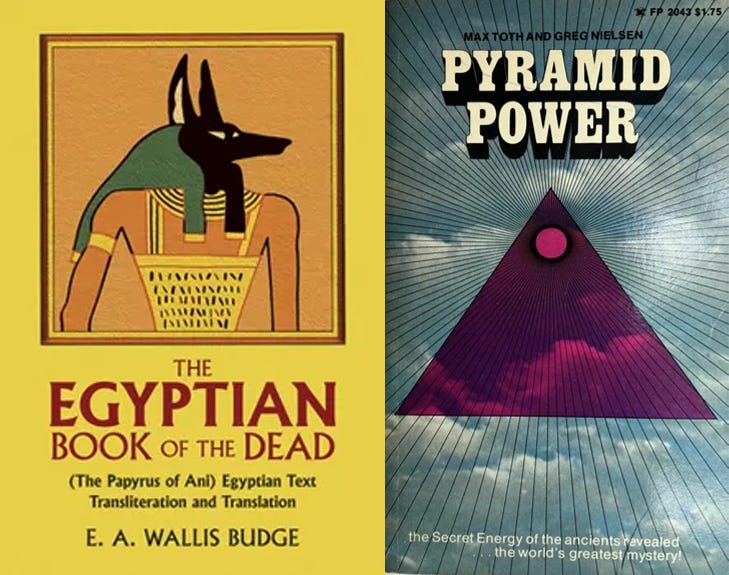
READ LIKE AN EGYPTIAN - Budge’s Egyptian Book of the Dead (left) was a fascinating first exposure to Egyptian hieroglyphs and sparked my early curiosity about ancient languages, linguistics, and non-Judeo-Christian philosophies and religions. Pyramid Power on the other hand (right) allowed me a wear a pyramid hat years before Devo tried to cop my style (albeit they called them “Energy Domes” and they were based on a Bauhaus light fixture.)
If there was anything that got more media attention in the 70s and captured the popular imagination even more than psychics or King Tut, it had to do with what was going on over American skies. Between coverage of NASA’s moon shots and reports that the Russkies were up there watching us from satellites and spy planes, the eyes of our nation were glued to the heavens with a mixture of both amazement and fear. All of us were wondering what was really going on up there? Was that moving dot a plane? A satellite? A weather ballon? A flight of starlings? Swamp gas? Venus? Angels? Could it be that all those reports of UFOs on the evening newscast were actually aliens in flying saucers visiting us from some far-off star?
Today we live in world where virtually everyone is carrying a relatively good camera with them at all times. When there’s a strange light in the sky, there’s a good chance that there will be dozens, possibly even hundreds of photos and videos taken of that same object that will appear almost instantly on social media. It’s easy to see most of these objects for what they are, absolutely ordinary phenomena that might be visually interesting but have entirely earthbound explanations. But the nature of UFO investigations in the 70s (and for that matter investigations of cryptids like bigfoot or the Loch Ness monster) was an entirely different experience. Quality photos were almost non-existent. Mostly there were blurry Polaroids, under-exposed slides, and lots and lots of bad drawings. Few witnesses were willing to come forward and talk publicly about their experiences for fear of ridicule, but nevertheless everyone had a cousin, or a neighbor, or a co-worker who was happy to share the story.
Little serious analysis of these events was available to the public, though a whole cottage industry of UFO-related magazines began to fill newstands by the middle of the decade. As a kid I hungrily grabbed up every issue of the UFO Report I could get my hands on. At the same time, I got to know the names of research organizations like MUFON that had been founded in 1969, and important UFO researchers like J. Allen Hynek who had been a scientific advisor to the U.S. Airforce for Project Blue Book, a secret government program that had been tasked with finding out the truth about UFOs.
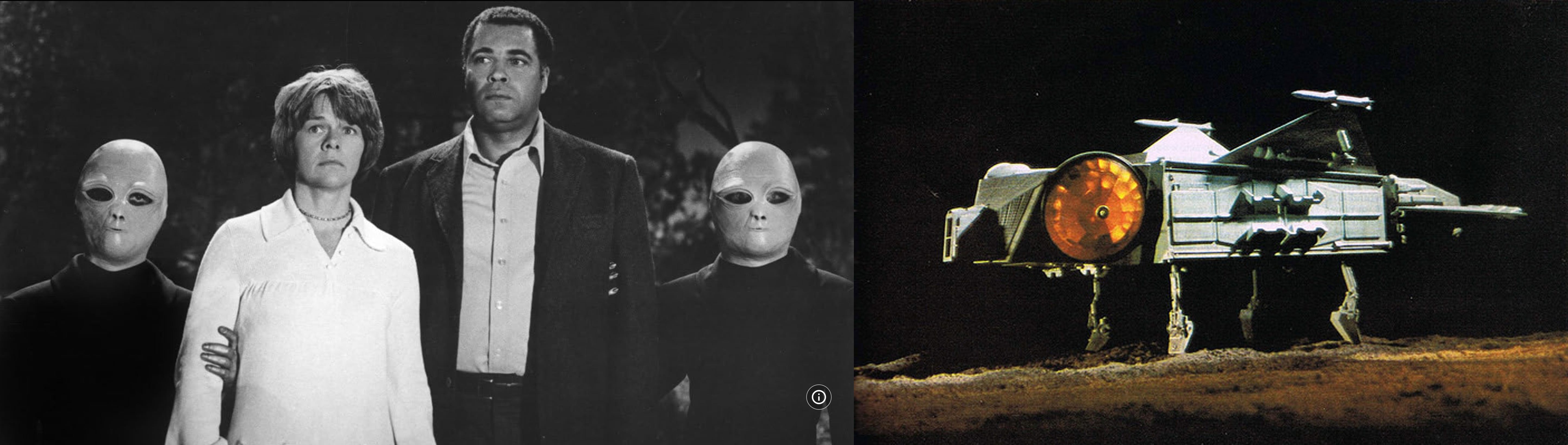
THEY CAME FROM THE TV - The UFO Incident (left) was a 1975 made-for-TV movie starring James Earl Jones and Estelle Patterson about the famed case of Betty & Barney Hill, a couple who claimed to have been abducted by aliens in 1961. Project U.F.O. (right) was produced by Jack Webb (of Dragnet fame) using files from Project Blue Book as the foundation of episodes for his television series which ran for two seasons on NBC. I remember watching both of these UFO centered productions when they first aired.
When it came to “big names” in UFO studies in the 1970s, no one juiced up the paranormal conspiracy community like German whackadoodle author Erich von Däniken. His Chariots of the Gods — first published in English in 1969 and then released as a documentary in the U.S. in 1971 — famously asserted that not only were space aliens real, but they had been visiting Earth since our ancient past, and have been actively intervening in our evolutionary progress all along. According to him, the Egyptian pyramids were obviously of alien design since they were too sophisticated for humans to have built (rude and insulting to ancient humans everywhere, and absolutely dead wrong). He also said that the Nazca lines in Peru had to be alien landing strips since they were clearly meant to be observed from above. Another one of his famous claims was that the special shape of the ark of the covenant (see, I promised you we’d get back to this) demonstrated that it had been designed by aliens as a psychic capacitor.
While von Däniken’s list of “contributions” to anthropological knowledge and serious research into parapsychology is long, damning, and deeply egregious, he unquestionably had an impact on pop culture. Without his mixture of UFOs and ancient cultures, we very well might never have experienced Raiders of the Lost Ark, X-Files, and Stargate, all of which borrowed from Däniken’s store of poorly conceived conspiracy theories and extraterrestrial mythologies.
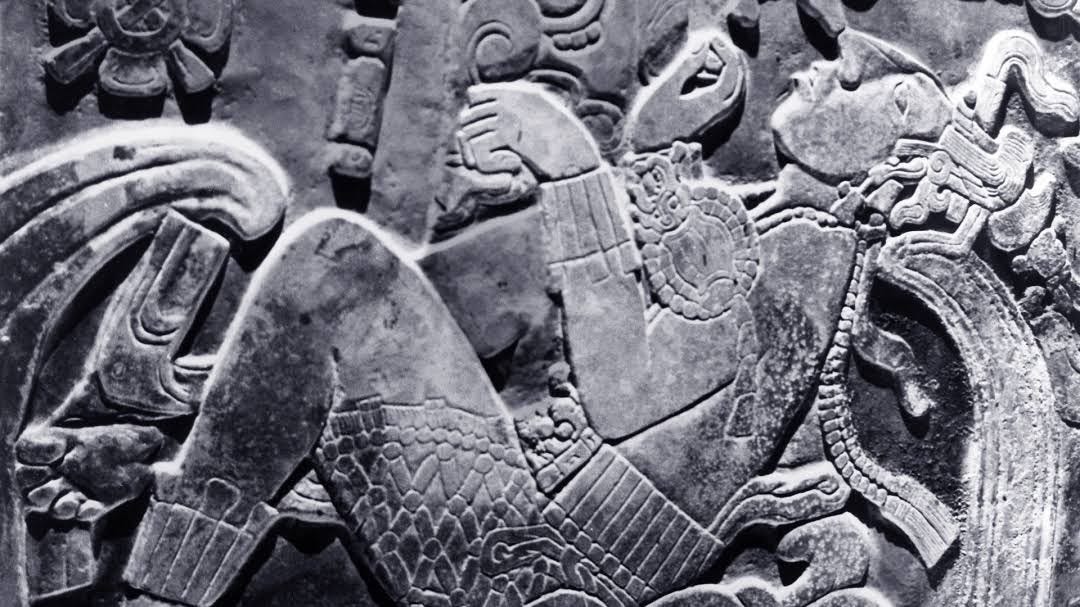
ROCKET MAN - Another one of Erich von Däniken’s claims is that the sarcophagus lid of Mayan King Pakal depicts the ancient ruler riding in a rocketship. Anthropologists counter that this is a completely uninformed interpretation of traditional Mayan iconography, and that the element von Däniken identifies as rocket exhaust is a traditional representation of a snake, and Pakal’s outfit is not a spacesuit but traditional Mayan regalia.
So before we bid farewell to this final entry of the Supernatural 70s series, I would be remiss if I didn’t devote at least a few lines to everyone’s favorite cryptid, the great American skunk ape, aka sasquatch or bigfoot. Although there were never so many reports of it as there were of UFOs, sightings of the big fella were still regular enough to keep my friends and family interested in someday going out to try to get a picture of one. I always knew someone who knew someone who claimed that they’d seen one walking through a field on their farm, or crossing in front of their car on a country road in the middle of the night, or looking in their window, or even banging on the door of their trailer. But no one ever had any pictures, and no one had footprints. He was like smoke, a ghost, a story. A boogeyman that you really didn’t want to encounter.
Of course, growing up in Indian Country, I also heard stories about other creatures, a ghost panther that was said to be haunting the hills near Stilwell, the deer lady paying visits to bad men in Adair County. But there was only one person I knew who claimed to have a first person encounter with a genuine creature of legend. My dear, sweet, Christian mother who would adamantly tell you she didn’t believe in such things admitted to me rather reluctantly that one time, when she was a little girl and alone on the farm, she had encountered a goat man. She’d found him standing at the end of the gravel road leading up to my great grandmother’s house. She described him as dark eyed, sporting a long beard and horns, and having a sack thrown over his back. He stared at her for a long moment, as if deciding something, and then at last he turned away and disappeared into the swirling dust of an Oklahoma afternoon. Who she thought he really was she would never say, but I definitely got the feeling she thought she’d been spared from something unspeakable that day.
And with that my dear friends, I come to the close of this series, and wish you the very spookiest and weirdest of all Halloweens.
#Paranormal #Occult #PeaceOfMindBooks #Tulsa #Telekinesis #KingTut #PyramidPower #UFO #Egypt #Cryptid #GoatMan
I think everyone definitely knows someone of someone who has a ghost story or spookum story! Chris's mom saw a spaceship floating but she's also god fearing and not a believer of any hoo doo. Ive heard of Castanada and read a bit of some of his books. Peyote is a helluva drug, would never could never. Also the ancient aliens guy? I know who he bit off now! That 60s nutball!