
The Supernatural 70s
Part II - The Month of Darkness

Yet this train’s whistle! The wails of a lifetime were gathered in it from other nights in other slumbering years; the howl of moon-dreamed dogs, the seep of river-cold winds through January porch screens which stopped the blood, a thousand fire sirens weeping, or worse! the outgone shreds of breath, the protests of a billion people dead or dying, not wanting to be dead, their groans, their sighs, burst over the earth! ―
Ray Bradbury, Something Wicked This Way Comes
When I was a child, the carnivals came in October. They arrived on billowing floats and with shrieks of calliopes, paraded through crowds of cotton candy-huffing children and balloon dispensing clowns, winding through the streets of the city until they at last arrived in the Tulsa Fairgrounds with all the raucous pomp and circumstance of a victory parade. And it was a victory, at least for me, the defeat of the summers that I found oppressive, of the heat that shut my lungs, of the days that were far too bright and too long for my dark-loving soul. They were the celebration of fall and of Halloween and of my birthday month all at once, and to me they were the heralds for the best days of the year.
In many parts of the country carnivals and circuses had largely lost most of their draw by the early 1970s, but in the Tulsa of my early childhood they still constituted major events. They brought with them all of the traditional carnival trappings: halls of mirrors, funhouses with shifting floors or optical illusion-inducing architectures, “freakshows” featuring belly dancers, bearded women, two-headed calves, dubious cryptid curiosities strung together with baling wire and displayed under low-lighting. All of these came and went every year, but one ever-popular horror-inducing attraction during the fair was actually a permanent resident at the fairground-adjacent amusement park, Bell’s.
Bell’s Amusement Park opened in 1951 on the Tulsa State Fairgrounds. Founded by Robert Kiwanis Bell, it originally featured seven rides, and in 1968 would became home to one of it’s star attractions, the wooden roller coaster called the Zingo. In 1971, Bob Bell and his park-founding father Robert decided that the further addition of a dark ride would help grow attendance at the park so they turned to existing east coast attractions for inspiration.
Phantasmagoria, named by Bob, fused gore and ghostly apparitions in one of the longest dark rides of its time, delivering nearly seven minutes of horror for its riders. Its many shocks and scares are among some of my happiest memories of the Tulsa State Fair.
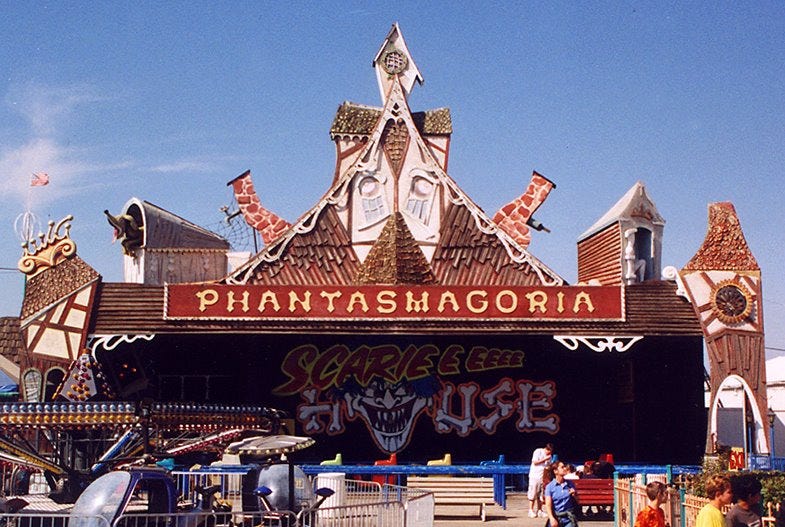
COME AND TAKE A DARK RIDE: Phantasmagoria opened in July of 1973 and remained in operation until its eventual demolition on June 19, 2007. Although the design of the dark ride was a collaboration between the Bell family and famous ride designer Bill Tracy, the carriages were entirely designed and built by the Bells, and replicas were later exported to dark rides at Joyland in Wichita, Kansas and Wonderland in Amarillo, Texas.
While Phantasmagoria would be the first dark ride I’d ever set foot on, it was not the only one of which I was aware. I’d first caught a glimpse of the granddaddy of all dark rides during a re-run of one of my favorite Sunday night television shows, Walt Disney’s Wonderful World of Color. In 1970, Kurt Russell and the Osmonds took a special tour of the recently opened Disneyland attraction, The Haunted Mansion.
For the rest of my childhood, The Haunted Mansion would become my most begged-for travel destination, but the cost was too prohibitive for my parents to make the long-distance visit from Oklahoma. Exiled in the Sooner State, I had to content myself with visitations via news articles or photographs. When Viewmaster released their reels with 3 dimensional views inside, I spent many joyous hours drooling over the stereographic images of the 999 happy haunts inside their creepy Victorian home. I was particularly entranced by the images of Madam Leota floating in her crystal ball, of the ghosts dancing in their ballroom, and of the top-hatted ghost performing at his pipe organ. These were images that would haunt my dreams for nearly a decade until I’d finally make my first visit to Disneyworld as part of a high school band trip to Orlando in 1981.
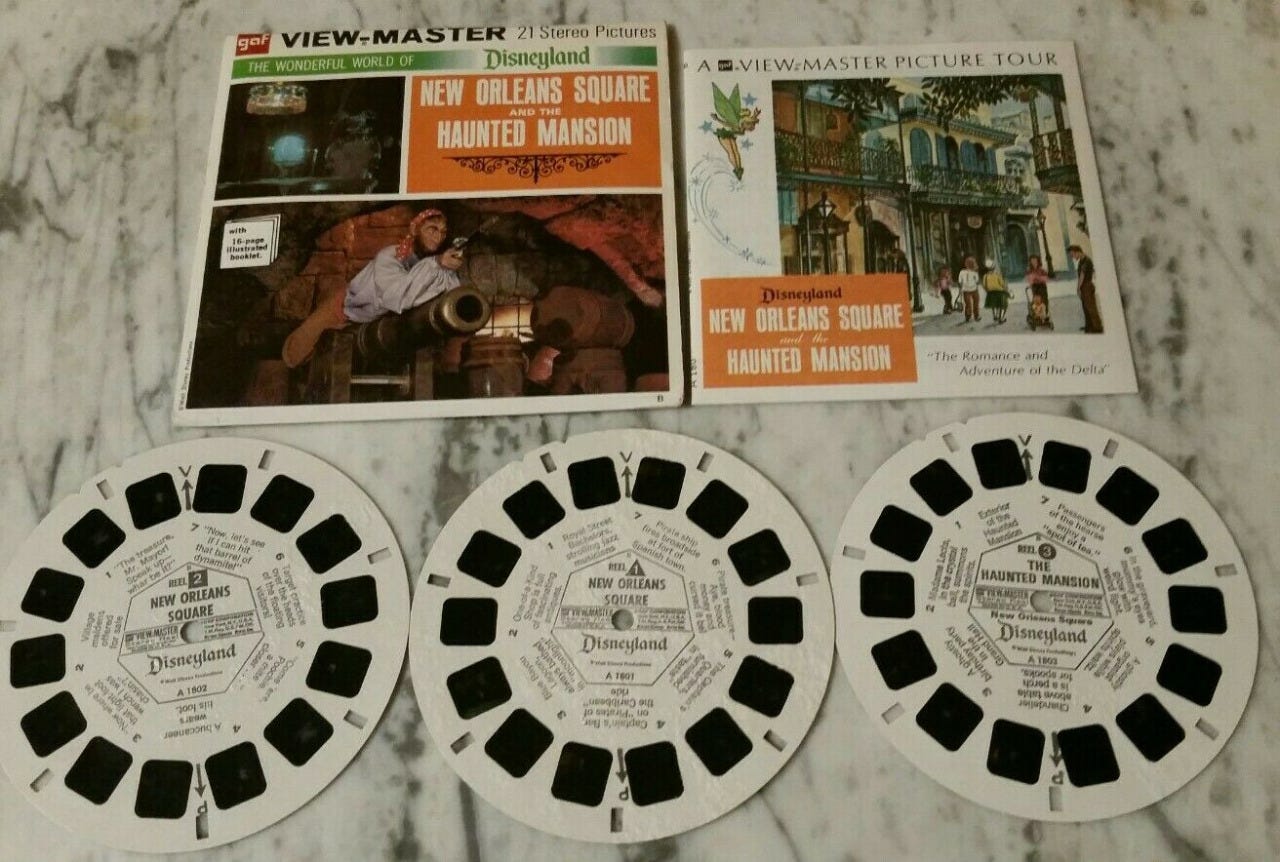
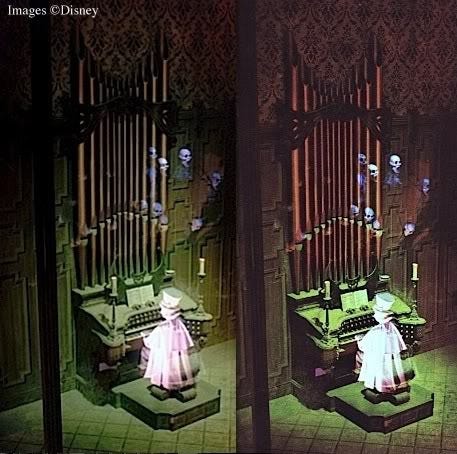
WELCOME FOOLISH MORTALS!: One of the many stereoscopic images of the Haunted Mansion that were available on the Viewmaster. As awesome as it was, my first in-person visit to the Mansion felt like a dream coming to life.
Another classic piece of Halloween-themed Disneyana was a party album originally released in 1964 featuring narration from actress Laura Olsher (the narrator is often misidentified as actress Greyson Hall, best known for playing Dr. Julia Hoffman in the gothic soap opera Dark Shadows). Re-released in the 1970s, the Chilling, Thrilling Sounds of the The Haunted House threaded together ten stories narrated by Olsher on the first side, while the second side isolated the sound effects into individual tracks of screams, thunder, lightning, fighting cats, dogs, creaking doors, explosions, crashes, birds, drips, and flying saucers.
During the 70s, the Chilling, Thrilling Sounds of the Haunted House practically became a requirement if you were planning a holiday party or celebration. You could find it for sale at major national department stores like Sears, at local Oklahoma retailers like T.G.&Y., and sometimes even at convenience stores in the candy aisle. When I went out trick or treating, half the houses I visited had the record playing in the background, and my own family wore out at least three copies of it during the years we were handing out Halloween candy at my parents home. To this day, it still serves as the official soundtrack of my childhood memories of Halloween.
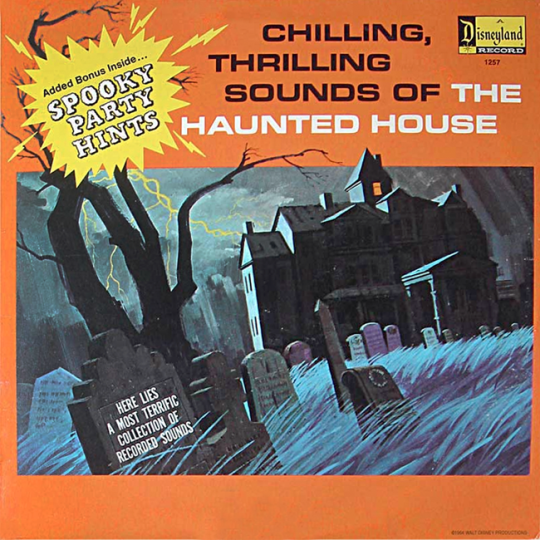
SPOOKY SOUNDTRACK: The original version of the Chilling, Thrilling Sounds of the Haunted House released in 1964 featured a white sleeve, but for the 1973 re-release the sleeve was recolored orange. The same piece of art by Paul Wenzel appeared on both versions, and was the original concept art for Disneyland’s Haunted Mansion.
If, like myself, you grew up between the 1950s and the 1980s, chances are you had two options for obtaining a Halloween costume. You could either fabricate one yourself out of your parents’ discarded clothing, old sheets, your mother’s makeup kit, and possibly a discarded box, OR you could trot down to your local five and dime and pick up the always reliable costume in a box. For around five bucks you could live out your fantasy of being Dracula or Frankenstein or Snow White or Batman or maybe a cat, and you might even get the chance to wear it two or three times before you either outgrew it or it simply fell apart. (Although the boxes for these costume kits always prominently displayed that they were flame-retarded, it was not at all too uncommon to hear a horrifying story about a kid accidently setting these costumes on fire because of an unwatched jack o’ lantern candle).
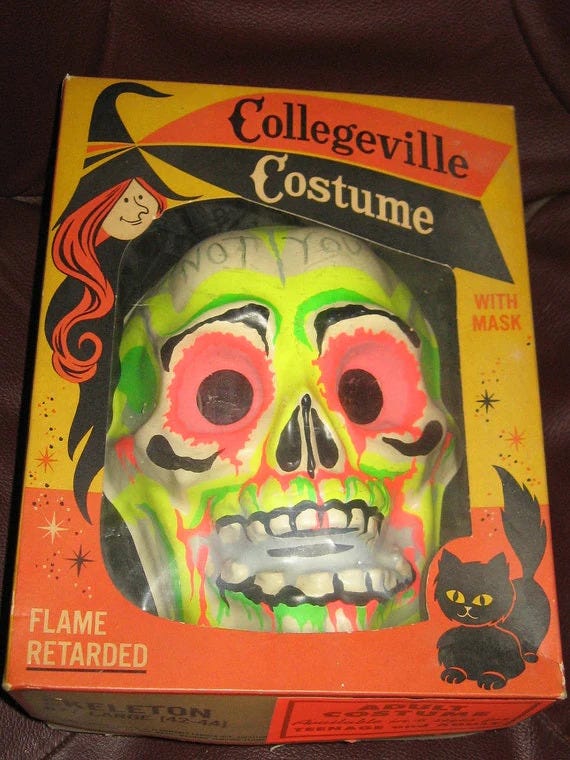
TERROR IN A BOX: During my childhood I owned a costume in a box kit identical to this one and have strong memories of rampaging through my neighborhood in it while in search of sweets.
As the seventies wore on, I grew more exacting in my standards when it came to Halloween masks and apparel. The “costume in a box” simply wasn’t cutting it for me anymore. Higher quality and more realistic-looking full head latex masks were appearing on the market by the mid-decade, and after a great deal of nagging I convinced my mother to purchase my first legit mask, a terrifically-rendered Creature From the Black Lagoon mask at the Top Hat Magic Shop (at the time the best place in Tulsa to buy or rent costumes). Later on, I’d add a magnificent Mummy mask to my collection. Likely I would have continued to fill the walls of my room with all the heads of my favorite Universal Monsters, but money, wall space, and the limits of my mother’s patience kept that fantasy from ever materializing.
By 1975 I had grown into a serious fan not only of the stars of the Universal horror movies, but also of the special effects and make up teams who had made those movies possible. Then, when the October Scholastic Books catalogue arrived that fall, I found a book that would forever ignite my interest in special effects make up techniques. Movie Monsters: Monster Make-Up & Monster Shows To Put On by Alan Ormsby provided a step-by-step breakdown of the makeup that had been used on several classic horror movies. More than that, it also provided detailed, richly illustrated instructions on how to create monster effects using things that would be available in ordinary people’s homes. In short order I was fashioning werewolf faces, and Frankenstein heads, and mummy hands all on my own (while also wrecking my parents’ home in the process...sorry mom)!
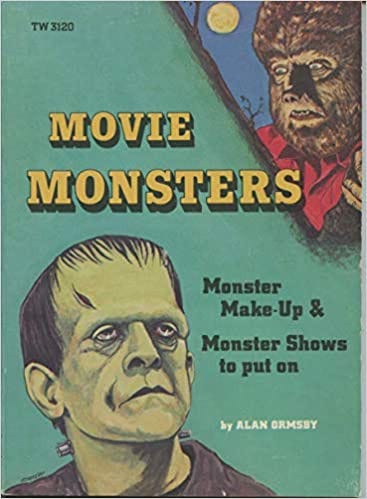
HOME MADE MONSTERS: Movie Monsters: Monster Make-Up & Monster Shows To Put On by Alan Ormsby was published by Scholastic Books in 1975. Many of the make-up techniques it demonstrated would spark my interest in filmmaking, and would influence my thoughts on the making of our classic noir horror short, The Case of Evil.
I don’t think most people remember when or why they stopped Trick or Treating, but can pinpoint it to the year of my thirteenth birthday. As usual, my best friend, neighbor, and years-long Halloween co-conspirator David Guthridge and I grabbed our candy bags, put on our costumes, and set out to roam the night as we had on so many Halloweens past. We swept along our street, hit all our usual spots, laughing as compared our loot just as we had for all the years of our lives. At last we came to a house on the street behind our own, one we had visited many times, and we rang the doorbell, and we waited.
The porch light flickered. An old woman came to the door. Reflexively we held out our bags and uttered the magic incantation.
“Trick or Treat!”
But the old woman didn’t open the outer screen door. She didn’t smile or laugh. Her eyes went wide and her mouth gaped, and her expression filled with a look of abject terror.
“WHAT ARE YOU DOING HERE?!” she screamed.
“We’re just treat or treating, maam. See...”
“No you aren’t! You’re too old to be trick or treaters! Get out of here!”
“We’re sorry...”
“GET OUT OF HERE! I’M CALLING THE POLICE!”
And her door slammed in our faces. We turned and ran. We ran as fast as our legs could carry us so that we could get back home, ran so the the police couldn’t find us and charge us for being too old for trick or treating, too old for candy...
Too old for Halloween.
In the years since, that memory has always stung. It’s the defining moment at which I can say that my childhood officially ended...at least by the definition of others. To me, I’m still out there in the dark, on that porch, wondering how I was mistaken for a monstrous adult. It still hurts.
Years later I’d hear a song by Neil Young, a song he’d written when he became too old to enter a club with his younger-than-himself girlfriend. It reminds me eerily of what it was like that night on the last Halloween of my childhood:
Oh, to live on Sugar Mountain With the barkers and the colored balloons You can’t be twenty on Sugar Mountain Though you’re thinking that you’re leaving there too soon, You’re leaving there too soon.
#Halloween #Dark Rides #Bells #Haunted Mansion #Disney #Make Up SFX
THATS BULLSHIT you can trick or treat even as an adult. That woman was horrible. She corrupted you!
Thank you for taking me through a ride of all the pains of trick or treating and what you went through as a kid, a teen, and later, as an adult.
I remember how much you told me you liked Halloween!
This is YOUR time. Im glad you're happy but that lady was incorrect! Be free!