
From Gamer To GameDev: Part IV
There Are No Pecan Sandies in Lothlórien, Kid

“…and the sons of Denethor grew to manhood. Boromir, five years the elder, beloved by his father, was like him in face and pride, but in little else. Rather he was a man after the sort of King Eärnur of old, taking no wife and delighting chiefly in arms; fearless and strong, but caring little for lore, save the tales of old battles. Faramir the younger was like him in looks but otherwise in mind. He read the hearts of men as shrewdly as his father, but what he read moved him sooner to pity than to scorn. He was gentle in bearing, and a lover of lore and of music, and therefore by many in those days his courage was judged less than his brother’s…Yet between the brothers there was great love, and had been since childhood, when Boromir was the helper and protector of Faramir. No jealousy or rivalry had arisen between them since, for their father’s favour or for the praise of men. It did not seem possible to Faramir that anyone in Gondor could rival Boromir, heir of Denethor, Captain of the White Tower; and of like mind was Boromir…”
— Appendix A, The Lord of the Rings, J.R.R. Tolkien
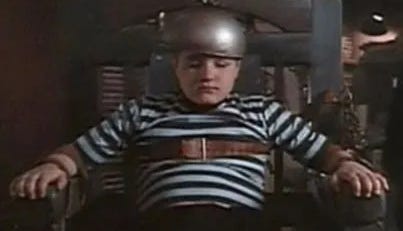
I’m not sure at what point my older brother decided to turn me into a science experiment. But I know when I actually became aware of it.
Like a lot of kids who have significantly older siblings — mine is nine years my senior — I looked up to Gene as an example for the kind of person I should be. As an adolescent, I first became a Trekkie because I enjoyed watching him watching Star Trek, and over time its philosophies and ethos became my own. I idolized him and his cool friends when they built ramps in our yard for their dirt bikes, and later developed an interest in playing music because I’d watched his band practicing in our living room on so many weekends. It wouldn’t be until he began to drive and started dating a girl that lived more than a hundred miles away that we spent much time apart, but even then, we remained very close. In many respects he served as a junior parent, babysitting me until I was old enough to graduate to latchkey kid, and even then he was my chief advocate against my parents when I began to rebel against their expectations for who I wanted to be and what I wanted to do. So much of who I am came from following his examples.
By the time I reached junior high, however, Gene grew less content to simply sit back and play a game of monkey see and monkey do with me. Now that I was entering my teens, I was developing this troubling — and dare we say it, irritating — sense of independence. I was listening to the wrong music. I was interested in the wrong things. After he’d gone off to study psychology, philosophy, and medieval history at Oklahoma State University, I’d wandered dangerously off the path he’d imagined for me. Obviously, drastic corrective measures needed to be made. He was ready and equipped to handle this existential crisis.
On some weekend when he was back home in Tulsa to do his laundry, he swept into my room with a stack of books in his arms. Tossing them on my bed, he informed me quite summarily that I had to read them all or he’d stop talking to me. If we’d had any kind of relationship other than what we had, I might have taken this as an easy ticket to avoid conversing with my sibling, but as I remind you, we were close. His approval still meant something to me, even if it also annoyed me. So, like a dutiful younger brother, I sorted through his gifts. What he’d brought to me were exactly the fluffy, light-hearted sort of books that anyone would give to their junior-high-aged siblings, stuff like Friedrich Nietzsche’s zippy ode Thus Spoke Zarathustra, or Arthur Schopenhauer’s heartwarming On the Suffering of the World, and Immanuel Kant’s hilarious The Critique of Pure Reason. You know, nice summer beach reads…if your I.Q. is somewhere north of Issac Newton’s.
To be truthful, I don’t know if his choices were based on a reflection of who he thought I was in that moment — i.e. assuming that I was actually smart enough to understand and process what I read — or if they were meant to push me towards what he believed I should become. Unquestionably, as explorations of some of the darker branches of philosophy, they dovetailed somewhat with all the Poe and Lovecraft that I’d been reading at that time. But between these daunting works of non-fiction, Gene had also slyly crowbarred in something that didn’t fit with the others. And when I say didn’t fit, I mean not at all. It was a slim novel, beautifully bound in green leatherette with gold leaf lettering, and it was fitted into a slipcase covered with the peculiar-looking letters of a runic alphabet I’d soon learn was called Cirth — a primary form of monumental inscriptions primarily used by the dwarves of J.R.R. Tolkien’s Middle Earth.
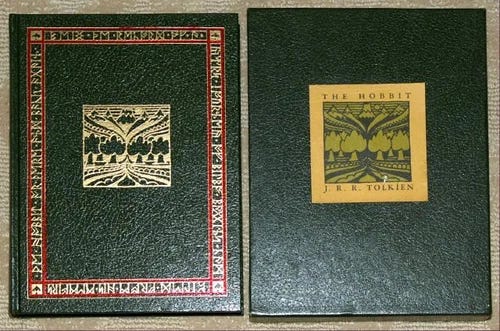
WHAT HAVE YOU GOT IN YOUR TBR PILESES?! Other than the King James Bible, I can’t recall having read anything before Gene’s reading assignments that was so beautifully and elaborately presented as Houghton Mifflin’s special edition of J.R.R. Tolkien’s The Hobbit, first published in 1973. A year later, The Lord of the Rings got a similar treatment with a honking huge omnibus edition bound in red leatherette and stamped with gold and blue lettering. Both are still in Gene’s personal book collection.
Gene’s “reading suggestion” was not my first encounter with Tolkien’s works. To the best of my recollection, a much less impressive copy of The Hobbit had resided on the very same elementary school bookshelf where I’d discovered Bradbury’s The Halloween Tree. It was squeezed right up against The Lion, The Witch, and the Wardrobe, written by Tolkien’s old pal and fellow Oxford prof, C.S. Lewis. For whatever reason, I’d never felt compelled to pick up The Hobbit at that time, but had hungrily devoured the stories of Narnia instead.
I have to admit that I hesitated before picking up The Hobbit. Even without having read a page of it, I knew the story was filled with elves, and dwarves, and trolls and sparkly unicorns…and without proper context it sounded positively childish to me. If I’d picked it up at the same time that I’d read C.S. Lewis, I’d likely have gobbled it down with the same enthusiasm. But by the age of thirteen, I was becoming A Very Serious Person. I read Very Adult Things and thought Big Adult Thoughts! I was weaning myself off comic books, and didn’t want anyone to catch me reading something that had — heaven forfend — pictures in it! How could I seriously discuss a book with any adult that began with “In a hole in the ground there lived a hobbit…?” Furthermore, I had to wrestle against my deeply enculturated pre-conceptions about what elves and dwarves were, how they looked, how they behaved, and what their complex fictional origin stories might entail.
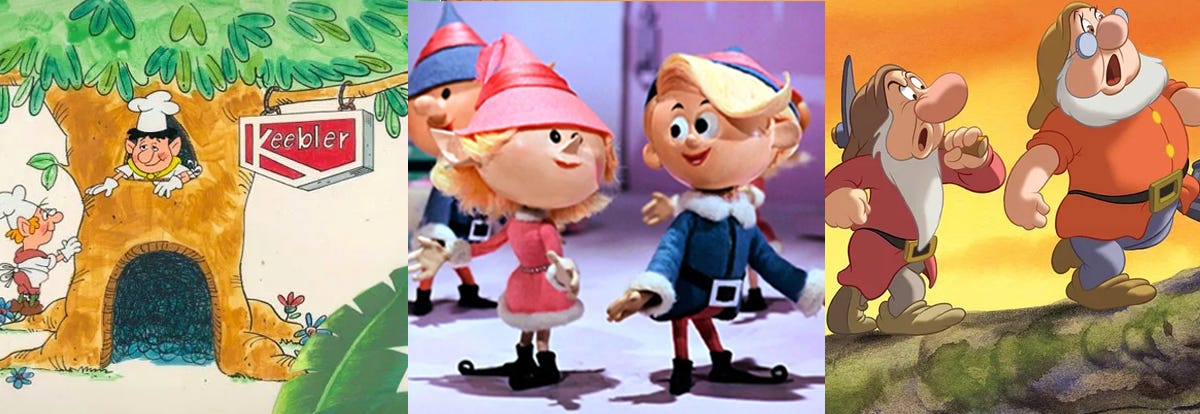
THESE AREN’T THE ELVES & DWARVES YOU’RE LOOKING FOR - Representations of elves and dwarves were everywhere in my childhood, but they bore little resemblance to those found in Tolkien’s Middle Earth. (LEFT) Ernie the Elf of Keebler cookie fame appears in this advertising artwork from 1970. (CENTER) Ah, the heartwarming seasonal tradition of watching Herbie the Elf (or Hermee, depending on your ears) in Rudolph the Red Nosed Reindeer as he’s persecuted for coming out as a dentist to Santa’s head elf. Joking aside, this goofy, animated Rankin Bass special from 1964 cemented mainstream perceptions of elven life long before Tolkien’s works exploded into counterculture popularity in the late 60s. (RIGHT) The seven dwarves from Disney’s Snow White come much closer to resembling Thorin Oakenshield’s people from The Hobbit, but it’s unsurprising given that the story is derived from the same Germanic myths upon which Tolkien built his hearty underworld heroes.
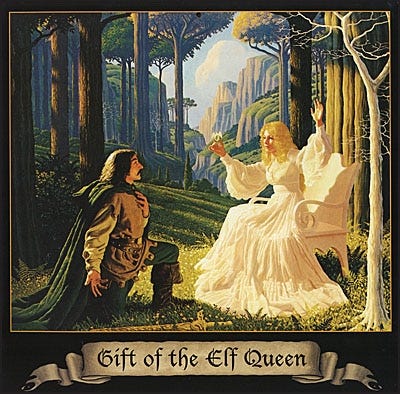
ALL WILL LOVE ME AND DESPAIR - My rehabilitation from skeptical elf doubter to Elendil (“elf friend” in the elvish language of Quenya) was greatly aided by the illustrations of Tim and Greg Hildebrandt for the Tolkien Calendars published by Ballentine Books between 1976 and 1978. Later, when director Peter Jackson adapted The Lord of the Rings and The Hobbit, he leaned heavily on the Hildebrandts’ lush romantic imagery to inspire the art direction of his films. For me, their work continues to be the definitive way that Middle Earth should be portrayed.
Once I’d got past my preconceptions and cracked open The Hobbit I was immediately assaulted with what quite probably is one of the longest and most tedious opening chapters of any book of fantasy literature. Seriously. Tolkien clearly hadn’t got the memo about starting a story in media res (that’s Latin for “in the middle of things”) which is what every fiction writer is taught today…but then again Tolkien wasn’t a modern writer. Even though The Hobbit was first published in 1937, his language and storytelling style were rooted not only in his studies of Victorian literature, but also the romantic Arthurian stories of the Middle Ages, and in the even older tales of Old English.
After I was able to slog past “The Unexpected Party” and all those damnable, interminable dwarvish songs, I actually began to fall in love with his language, and how he described his world of Middle of Earth. His imagery was vivid, his phrasing poetic, and his tale both inspiring and heartbreakingly tragic all at the same time. Along with Ray Bradbury, he taught me that the greatness of a storyteller didn’t lie just in the story they told, but also in the way they told it. You can get a story any day off the front page of a newspaper. What makes a story timeless and compelling and worth reading is to breathe poetry into it.
So once again, we have arrived at the question: what does any of this have to do with game design? As with my studies of Lovecraft, most of what I learned from Tolkien had to do with structure. The Hobbit and The Lord of the Rings comprised an epic consisting of literally hundreds of characters with incredibly complex, interweaving subplots unfolding over hundreds of pages. His works demonstrated how a single narrative could be broken down granularly into a series of dependent quests that have to be completed either in parallel or in series, and each of those quests can be a complex story in itself. The Two Towers — the second book in The Lord of the Rings trilogy — was particularly instructive because with the breaking of the Fellowship, all of its members are sent careening off on individual quests to accomplish things that have to be done to prepare for the coming war in Mordor. In Betrayal at Krondor, I pretty much lifted the whole of idea of the breaking of the Fellowship so that we followed Locklear, Owyn, Gorath, and Jimmy on separate but parallel quests that had to be completed before the end of the game.
While we’re on Betrayal at Krondor, we can also talk about another connection, specifically with The Hobbit. One of the most popular features of Krondor were the numerous riddle chests which evolved out of a conversation between project lead John Cutter and I about the riddle game between Bilbo and Gollum. We had been discussing how to rationalize the existence of all these loot crates that we were planning to scatter around Midkemia, and then struck on the idea of using riddles as a way to open them. John would invent the mechanics and interface for the locks, and Alan Roberts would crank out the vast majority of the riddles, but the inspiration had begun with J.R.R. Tolkien.
The third and most important thing that I learned from The Lord of the Rings came not from the main text but from its inclusion of several appendices. It’s not unusual for fantasy novels today to carry maps, glossaries of character and place names, and the odd genealogical tree or two, but Tolkien took this concept much, much deeper than any author before him. He laid bare all of his worldbuilding ideas for Middle Earth right alongside the work he’d just presented. It was groundbreaking, unheard of, and it allowed readers to peek over his shoulder to see the process he’d gone to build the world of Middle Earth. He explored the history of the world, the back stories of his characters, delved into the evolution of the myriad different languages that he’d created whole cloth for these books. He presented what essentially was a series of research papers into his fictional universe. It was the kind of toolkit I’d wished that Lovecraft had made available for other writers (and readers) of his Cthulhu Mythos, but for me it provided a roadmap for the kind of work I’d later need to put into building fantasy worlds for games and works of fiction of my own.
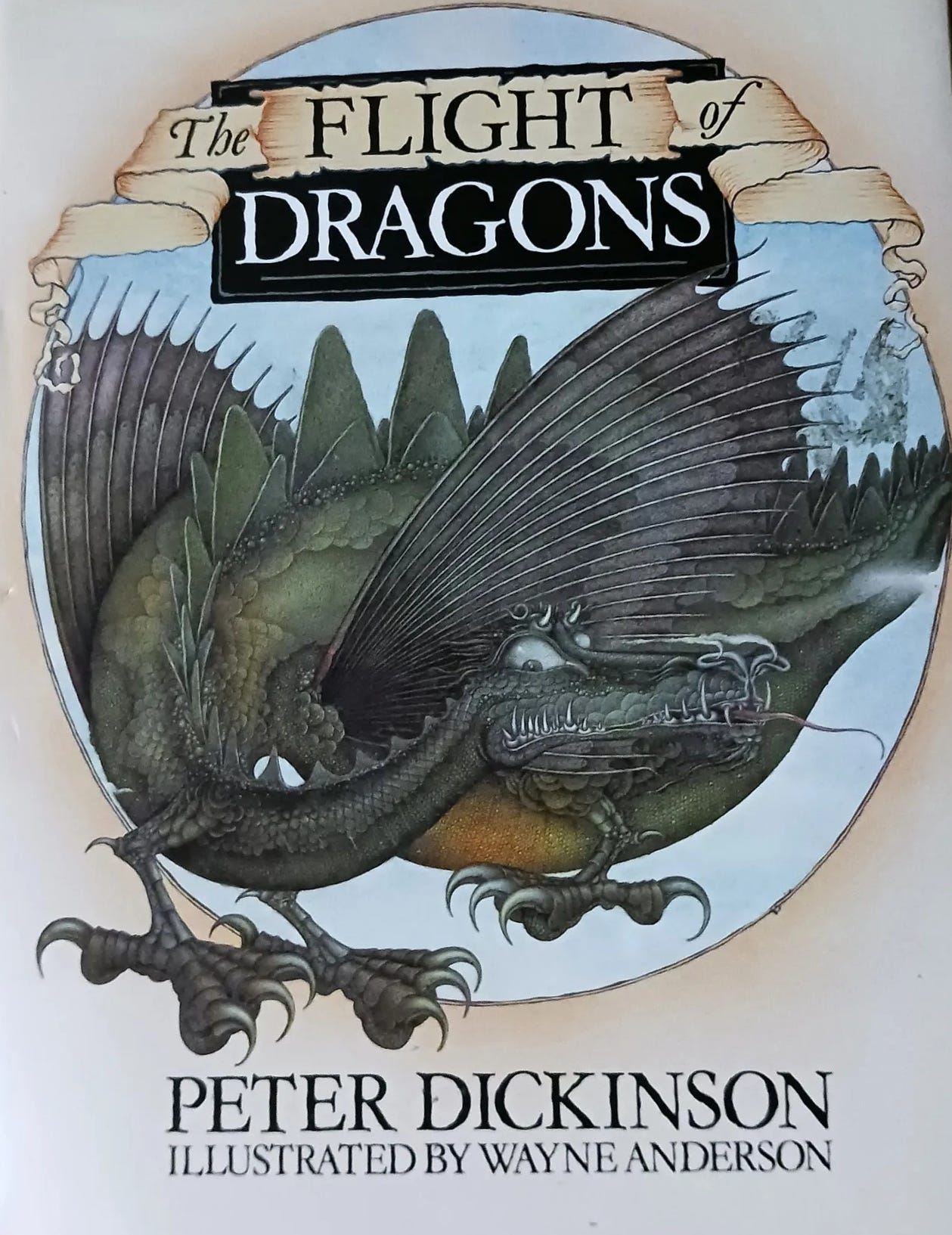
SMAUG ALERT - While we’re on the topic of fantasy worldbuilding, there was another book in my brother’s collection that had nothing to do with Tolkien or his works directly but attracted my attention because I’d become fascinated with the dragon Smaug featured in The Hobbit. Written by Peter Dickinson and illustrated by Wayne Anderson, “The Flight of Dragons” published in 1979 by Pierrot Publishing was a whimsical but also semi-serious attempt to explain how such tremendously large creatures could have flown and breathed fire. Dickinson’s approach is surprisingly rational, rooted in scientific rather than magical explanations which allowed me to reimagine the mythical creatures of my childhood in somewhat more credible ways. It also allowed me to see how they might shape the ecological niche they occupied, and how that in turn would change the worlds in which they lived. When combined with theories of scientific evolution presented by James Burke in Connections, it became another important piece of my worldbuilding toolkit, all thanks to my curiosity about Smaug.
The last important way in which The Lord of the Rings influenced me is that it allowed me to set aside my pre-conceptions about mythical creatures and about magic so that I would be receptive to a game that was about to transform everything I understood about gameplay. Had I not read Tolkien’s works first, I might never have picked up my first set of twenty-sided dice, never died a thousand deaths at the hands of kobolds or owlbears or gelatinous cubes, never found myself wandering in blind dungeons for hours on end and fighting dragons of countless hues, nor spent so many hours with close friends as we worked together to vanquish great evils and hook up with succubae. Thanks to my brother’s required readings, I would very soon be ready to take my first heroic steps into the multiple worlds of Dungeons & Dragons.
#LOTR #TheHobbit #JRRTolkien #Fantasy #Riddles #Smaug #NarrativeDesign #Krondor #Worldbuilding #Brothers
I think this is my favorite post yet!
Seriously, its going to be hard to top this.
The grail of Jackson's Rings series i will probably play on my deathbed. I didnt like the books as much, sad to say.
I watched the cartoon Flight of Dragons and LOVED it. I didnt know it was a book! I learned something today. Absolutely agree with how they approached how fire breathing dragons used to exist was so novel.
I see this as a love letter to the fantasy genre and it so sweet. I also love the D&D twist at the end, where you end fighting gelatinous cubes and rolling a twenty sided die.
This is gonna be hard to top as far as im concerned, for my personal happiness. Its gorgeous.