
KTOW, The Shadow of the Bulldog Man, and the Birth of Uncharted Regions
Or How I Did Something Naughty With a Big Transmitter

There is a fifth dimension beyond that which is known to man. It is a dimension as vast as space and as timeless as infinity. It is the middle ground between light and shadow, between science and superstition, and it lies between the pit of man’s fears and the summit of his knowledge. This is the dimension of imagination. It is an area which we call the Twilight Zone.
--- Rod Serling, Introduction to The Twilight Zone
Shortly before midnight, three days after graduating from high school, I walked down a long hallway lined with photos of famous Country and Western stars. Conway Twitty, Dolly Parton, Loretta Lynn, Hank Williams Sr., Bob Wills, and Roy Clark were all watching me. I was keenly aware of Roy’s gaze in particular because my father was a huge fan of his, and Roy was a legend in the world of Tulsa entertainment. Mr. Clark had played a very important role in the foundation of where I was, and it was more than a little surreal that I was actually here, in a place where Roy’d worked on a nearly daily basis for many years.
I took several turns, following the sound of drifting music. My best friend Ron Bolinger was in the middle of his show, so I just waited to the side for him to finish, not wanting to intrude on his magic. I was nervous. I knew I wouldn’t be alone tonight, but stage fright isn’t always rational. Unlike many of my musician friends who were lucky if they got an audience of even a few dozen people at their first gig, I knew my first audience would number in the hundreds -- possibly even thousands. Over the course of the next six hours, I’d be responsible not only for entertaining the people of my hometown, but also for people who might be listening in from Nebraska, or Tennessee, or even my future home in California.
I was only seventeen years old, and they were giving me the keys to an AM radio station for the night. Clearly, they had no idea what they were doing.
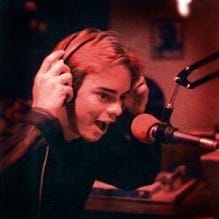
THE KIDS ARE IN CHARGE - Ron Bolinger at the microphone at KTOW during one of his shifts.
KTOW was more than just the local C&W station, it was an institution in my hometown of Sand Springs, Oklahoma (a little community just seven miles from downtown Tulsa.) Owned by Red Graham, the station was essentially a real-life version of TV’s WKRP in Cincinnati, run by an equally colorful cast of staffers. Kay, our receptionist, was very much like TV’s Jennifer in that she often seemed to be the only person who knew what was actually going on most of the time. Our Johnny Fever was an Elvis impersonator who owned his own vintage record store in Crystal City, and he often arrived for his shift on his motor cycle while sporting a leather jacket and full pompadour. Another DJ, Mark Maxey, got himself fired from the station for lampooning Oral Roberts’ infamous “500 foot tall Jesus” debacle, but quickly found that he’d become a national celebrity as a result of it, with calls coming in from all directions, including an invitation for a spot on Johnny Carson.
With so much madness going on at the station all the time, it fell to our program director, Michael Graham, to keep we lunatics from destroying the asylum. We didn’t make it very easy for him to do his job. Every few weeks he’d have to sit us down with our on-air tapes (recordings of our shifts) and he’d have to explain how to do our jobs better. Being that we were an Oklahoma station, one frequent topic of our meetings usually involved diction -- or rather the complete lack thereof with some of our DJs (not me, thankfully, as my mother had gone to great lengths to de-Okiefy me as a child). “The name of our station is K-T-O-W,” he would carefully enunciate time after time. “Not K-T-O-Dubbyah! Try not to sound like complete hicks on the air!” Another fascinating fact about Mike was that he was completely blind. This meant that every record, tape, and cart in the station was covered in braille (I remembered at the time being fascinated with this, as it was my first time to actually come in contact with it outside of watching the Hellen Keller story on TV). Some people who didn’t know Mike at first would make the mistake in thinking they could pull things over on him, but Mike was a very sharp cookie. He wasn’t easy to fool, and knew how to run the booth better than any other five normally-sighted DJs put together.
Being a small family-owned station, the atmosphere was relaxed -- sometimes probably far more than it should have been. Many of we DJs were very young, in our late teens to early twenties. We frequently pulled pranks on one another. When a new trainee would come in, we’d tell him that the mysterious red button on the sound console should never be pressed under any circumstances, convincing them that it was reserved for use in the case of nuclear attack, and that it would blow up the transmitter so the station wouldn’t fall into enemy hands (this was the ‘80s, afterall.) We went to extravagant lengths to back this story up, and would always impress the importance of never touching THAT BUTTON...and then we’d casually push it, seemingly by accident, watching out of the corner of our eyes as the new guy lost his mind. (In actuality it was just a red button that had been connected to a non-functioning cart machine. It wasn’t connected to anything, and had been bypassed a long time before for reasons lost to history.)
There were, of course, also important lessons to be learned. Once I mixed up a gallon of chocolate Quik for my shift and drank half of it, only to become ragingly nauseous. I spent the rest of my six hour shift cursing my creator while running back and forth to the bathroom to puke, using the extended playtimes of Lynyrd Skynyrd’s “Freebird” and The Eagles’ “The Long Run” to cover my long absences from the booth. I also learned how to effectively kill time, reading the entire Dune series during Kansas City Royals games when I had nothing else to do between the commercial breaks and station IDs. I perversely remember that one time I opened up the mike during one such game and said, “I’m the Kwisatz Haderach, and you’re listening to KTOW.” If anyone ever noticed, only the Bene Gesserit know.
------
By the time I’d joined the station, it was already a relic teetering on the edge of extinction. Roy Clark and his millions had left years before, and what had survived him was a station that clearly had no clue what decade it was inhabiting. The gear in our on-air booth was chaotic, an anachronistic amalgam of tech, much of it dating as far back as the 1960s or possibly even further. At a time when most stations had transitioned to primarily using cartridges (commonly called “carts”) or cassettes, KTOW stubbornly clung to its aging record collection, the booth hemmed in on two sides by multi-tiered bins full of country and western acts that hardly ever graced the airwaves anywhere else. Even the production board itself was a dinosaur, its innards filled with a forest of dimly glowing solid-state tubes. Probably the only thing older in the station waited in the darkened closet next door, a good-natured teletype that on good nights had relatively little to say, infrequently bringing us the nightly weather forecast. On bad nights, however, it chattered constantly like a maddened hell beast as it hammered out the names of towns that might cease to exist as tornadoes and thunderstorms rolled across our home state.
While the on-air booth itself was like a room lost to time, the production suite was slightly more modern, but only by a fraction. It was a tiny room, barely ten by six. Reddish brown shag carpeting covered it from floor to ceiling, leftover I suspected from a time when Three Dog Night was singing to us about having been born in Oklahoma. I always thought the room really needed black light posters and maybe a lava lamp. Had it been another type of radio station, I might have been able to make that happen.
On most occasions, we used the production suite for the purposes for which it was designed, i.e. to cut commercials and public service announcements for local sponsors. But starting in the fall before I’d become a full-time employee, I had begun to explore the studio’s possible uses for an entirely different kind of project.
---
As Halloween approached in 1983, I was just a trainee at KTOW, learning the ropes of becoming a DJ from my good friend, Ron. As I so often did during his shift, I was parked one night on the ratty old leather chair across from him, and we were BSing between station breaks about the usual stuff, i.e. girls, things we were reading, and general philosophical nonsense. Mark Maxey was leaning up against the door frame, looking for all the world like Shaggy from Scooby Doo. The big topic of the night was ghost stories, and in particular, a local urban legend about a gruesome figure known as The Bulldog Man. As the local boys, Ron and I were the experts, filling Mark in on the details of the story as we’d remembered it from teachers and neighbors.
“It would be fun to have something about him on Halloween night for the station,” I said. Ron and Mark agreed, and we began to talk about what we might be able to do with it. At first it was a discussion about a color piece, just one of us telling the story of the Bulldog Man on an open mic, but the idea quickly snowballed. We wouldn’t just read the story, we’d play it out as a pseudo-documentary, a radio drama in the style of the classic Orson Wells version of War of the Worlds.
The more we talked about it, the more we fell in love with the idea. Ron and I were already both huge fans of radio drama, and had loved the adaptations of Star Wars, Lord of the Rings, and The Hitchhiker’s Guide to the Galaxy which had aired in recent years. It was agreed that I’d write the radio play and that both Mark and I would be presenters. Ron opted to be behind the scenes, but he’d help us get permission with the station heads to have it aired on Halloween night. For one and only production, we formed BONEMAX (we pronounced it BONE-E-MAX) with the objective that this might be the start of something much bigger.
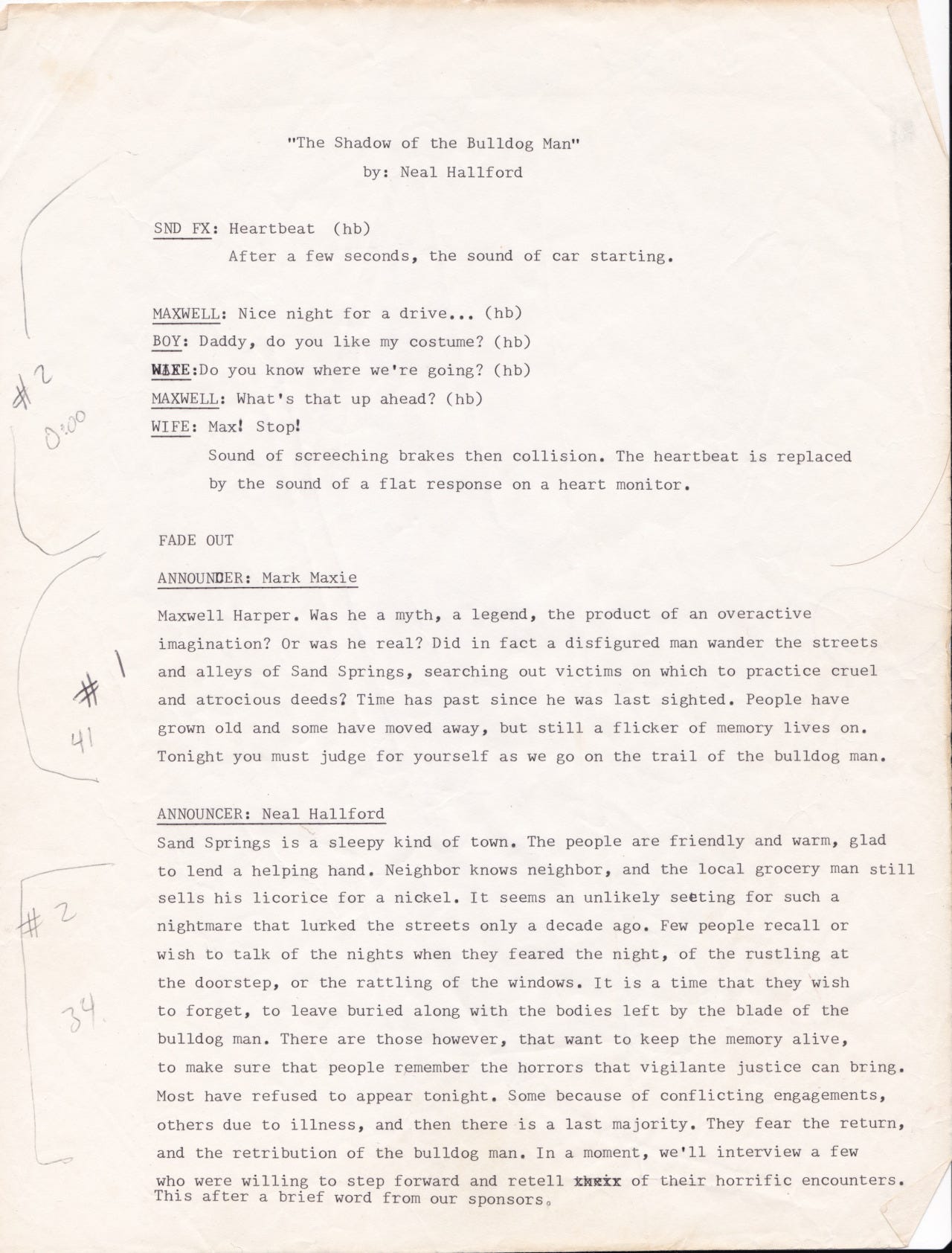
THIS IS NOT BARBARA WALTERS - The tone of the script for Shadow of the Bulldog Man had more in common with a television news program like ABC’s 20 / 20 than with a traditional radio drama script, but that was largely the point given that we were going for a “local” version of Orson Wells’ War of the Worlds that might be mistaken for an ordinary news broadcast.
The production of Shadow of the Bulldog Man came together incredibly fast, and probably resembled a 1980s version of Mickey Rooney and Judy Garland putting on a play in the barn. With no previous experience in producing anything but the high school magazine up to that point, I was making up everything as I went along. I hammered out the script on the Selectric III typewriter which lived in my father’s office at the high school, completing it in one sitting. Because of our limited time to produce, there was only time to create one draft of the script.
In a perfect world, I would have run auditions, but most of the parts were for adults, and most of the actors I knew were my stage mates from the high school drama class, and again -- time was an issue. The only thing I could do was grab people who I knew, and more importantly who I knew that would say yes. I’d do most of the heavy lifting in the script as the chief interviewer / narrator, but as previously agreed, Mark featured as well. We’d also pull in others: my good friends Rob Klarr and Corby Cannon, along with an anonymous woman whose name I’ve lost to time. The real casting coup though was arranged for by my father, who was not only a school administrator, but also an auxiliary police officer, giving us access to the actual Chief of Police for Sand Springs who gave us an “interview” about the threat of the Bulldog Man.
The recording and mixing of it posed another challenge as I was not yet an employee of the radio station but only a trainee, and to a degree we were still trying to fly under the radar with what we were doing. That meant all the recording and mixing was going to be up to me using my own equipment, and all that I had on hand at the time was a boombox which would allow me to bounce two tracks together with no control over the volume. It was not exactly an optimal production experience.
Being that BONEMAX was a skunkworks production within KTOW, we didn’t have promotional spots running in advance of the show, but we knew we had to get the word out so people would tune in. As it was the mid 80s, we took a page from the punk rock playbook, and we made ourselves a stack of flyers at Kinkos. As I busied myself with recording the various parts for the show, my friends Corby Cannon and Rob Klarr flocked out over the parking lots of the Southroads, Woodland Hills, and Eastland malls, papering windshields with our astrobrite posters for the show. God only knows what all those people thought about getting adverts for a radio drama.
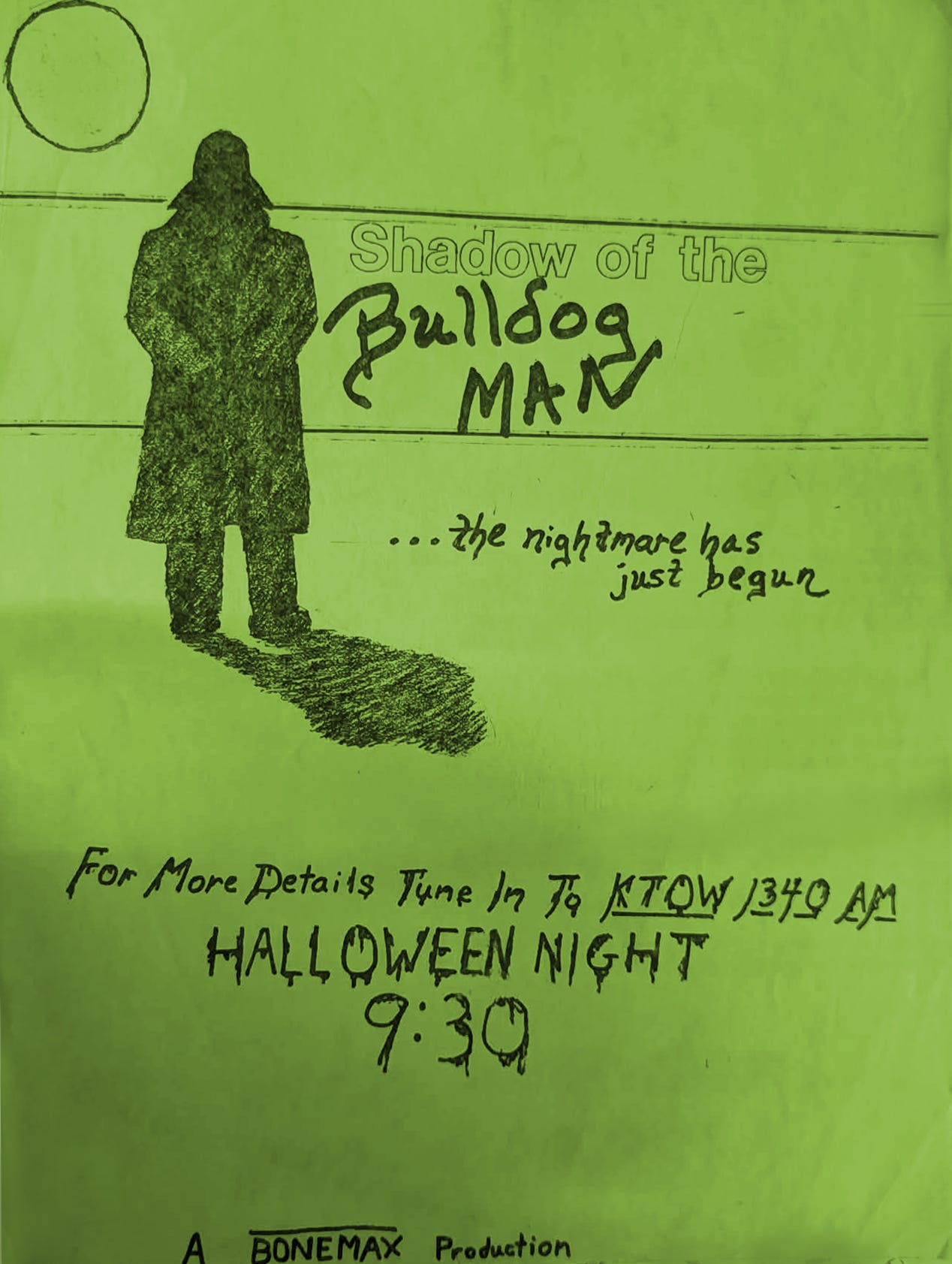
GUERILLA MARKETING - Suffice to say that we had no official marketing, the whole project was underground, and I had yet to meet Photoshop or Illustrator.
The night of Halloween, just a half hour before airtime, I was sitting in the sales office outside of the booth, frantically mashing buttons on my boombox as I worked to finish the mix for Shadow. The terrifying reality of it was that I’d never get a chance to preview it before it went live. For better of worse, whatever was on that tape was going to go out over the airwaves, and I hoped that I hadn’t accidentally erased everything in the process. Ten minutes before air, I handed the tape to Mark Maxey and I crossed my fingers.
It was showtime.
Amazingly enough, things went off without a hitch. Given the circumstances under which it had been recorded, it sounded better than I had expected, though none of us would be getting Oscar nominations for our performances. The big gimmick though was at the end of the show, and I hoped fervently we’d get some kind of response to what I had planned.
The overall premise of the show was very meta, and we treated it like it was a “live” broadcast, debating whether or not there was any validity to the local legends of the Bulldog Man. As the “reporter” on the show, I spent most of it poking fun at the story, and getting verification from various sources saying that he wasn’t real. Towards the end, though, we incorporated a “phone call” from someone claiming to be the mother of the bulldog man, and she’s warning us about the dangers of dredging up his supposed legend, and that he’ll be angry at being treated this way. From there the show goes on, ultimately ending with me signing off, and us transitioning into Mark’s usual evening music program. Mark starts to play a song, but then notes that he’s hearing something outside the station. There’s the sound of shattering glass...
...and then we killed the show. But we didn’t just cut off the music and his mic, we shut down the radio transmitter. It wasn’t just dead air. It was if there was no station on that frequency anymore. We were gone...
...and we left it that way for ten minutes.
Now this isn’t something you’re supposed to do. Technically, it was illegal. It’s probably something that back in the day I could have lost my FCC license over, and we certainly didn’t forewarn Mike or any of the rest of the managers at KTOW about it.
Somehow neither Ron nor Mark got fired over it, and the station still hired me the following spring.
---
After the “success” of Shadow of the Bulldog Man, Ron and I continued on with our interest in radio dramas as Mark drifted away. Just two months later we followed up with Silent Night, a story penned by Ron (in a more traditional radio drama format) that also starred the only real actor either of us knew at the time, Michael Shyers. In many respects it was a big step up in production value over Shadow, and we were permitted to record all of it in the production suite. Increasingly, we both got much more ambitious about the ways in which we used the studio. The midnight weather report became a semi-regular production event for us, and we’d report the Sand Springs weather as though it was being transmitted from Transylvania (complete with wolf howls) or Belfast (with goofy Irish accents and bomb blasts). When I switched over to an early morning breakfast shift, I created the Chickenbusters show in which I polled listeners for sightings of supernatural chickens. We’d both become addicts of a sort to the possibilities of the studio, but an even more ambitious project was still in the wings.
Between the time of Shadow and my going off to college at the University of Oklahoma, I’d seriously beefed up my home arsenal of recording equipment. I’d bought a Fostex 4-track recorder, mixers, microphones, sound processors, and a Yamaha DX-7 synthesizer. I could produce almost anything I wanted in the privacy of my bedroom studio, and with a level of quality that met or exceeded what I could create through the University’s sound lab at the time. I noodled with music pieces, but what I really longed for was another radio drama that would make full use of my improved writing and production skills.
Repeatedly I listened to episodes of Bradbury 13, a Peabody award-winning radio series based on the works of Ray Bradbury that mirrored my ambitions. I wanted to do something that for all intents and purposes would be Twilight Zone on the radio. I picked up the phone and called Ron, and once again he said he’d be up for trying to schedule a new show at KTOW, though I needed to be aware that both the owners and the format of the station had changed while I was away at OU. Likely we wouldn’t have any problems because the new station was now billing itself as “progressive radio” — which translated into alternative, reggae, or whatever other “outside the box” kind of rock they felt like playing — and that meant the new management might be even more open to the kind of anarchic, format breaking chaos that we had in mind. Before we got off the phone, we had a new direction, and a new title, and I was off to the races.
In 1987, we debuted Uncharted Regions, a weird tales anthology series that would provide the format for all of our future radio drama projects. The first episode was “Calls Waiting,” and had been recorded entirely in the kitchen of my apartment at OU, and starred our good friend Jimmy Hollingshead, who was the first semi-professional performer to appear in the official series. A few months later he would return in our second episode, “October Harvest,” which I penned in collaboration with Corby Cannon who had been one of our confused interviewees in Shadow of the Bulldog Man. “October Harvest” would be unique in that it was the only time that both Ron and I stepped behind a mic to star together in one of our productions (Ron had appeared in Silent Night with Michael Shyers, while I had played the part of a reporter in Shadow of the Bulldog Man).
After Halloween of 1989, Ron and I began to take Uncharted Regions very seriously. We wanted to move away from just being “special events” and instead wanted to turn them into a regularly scheduled part of the KTOW schedule. We met once a week to pitch story ideas to each other, and I filled a spiral notebook with story nuggets and with evocative-sounding titles which I began to flesh out into full scripts. “Haven” was inspired by the AIDS epidemic which was dominating the news cycles of the time, and I turned it into a very Bradbury-esque chase set in the far future. “Someday, Over You” began as a song lyric about my very recently broken heart at the hands of my high school sweetheart. Its title was inspired by the song “Someone To Watch Over Me,” and while listening to Ron’s trumpet-playing protagonist in his earlier audio drama Silent Night, the narrative of the ultimate story of heartbreak, fueled by the blues and an implacable supernatural force took shape almost on its own. (It also started me down the long road that would ultimately lead to the creation of my noir horror short, The Case of Evil (available here for paying subscribers)).
Of course, what Ron and I both realized was that if we really wanted KTOW to take us seriously, we’d have to do more than pile up a big stack of scripts. Even though we were both fairly good writers at that age, the stories alone weren’t going to carry the show. Good dialogue delivered by crap actors — namely us — wasn’t going to cut it any longer. We needed to raise the production values of the show to give it the best chance for success. It was time to reach out to the professional, and semi-professional, theatrical community of Tulsa.
Ambitiously we planned to launch the first official season on January 20th of 1990, reasoning that we should be able to record a couple of episodes a week, and spend about four or five hours editing each one (oh, how confident we were). With “Haven” and “Someday, Over You” both in hand, we proceeded to plaster every theatrical venue and educational center in the Tulsa Metro area with our homemade flyers advertising our auditions at The Gallery at the University of Tulsa on November 13th, and Room 331 A at Tulsa Junior College (now Tulsa Community College) on December 1st. Much to our pleasant surprise, we had about a dozen people show up to each one.
“Haven” was a cinch to cast, and as I recall we got our Jacobsen right out of the gate at the first audition. We scheduled the recording session at KTOW the week following, and the performances that our cast delivered were phenomenal. We were able to record all but a handful of the parts in about two hours, capturing the raw performances on the station’s shiny, new, high fallutin’ ADAT machine — at the time, the most impressive piece of recording gear I’d ever worked with in terms of audio fidelity. The plan was later to mix everything down to the other piece of new equipment at the station, a Fostex B-16 which was the first ½” 16 track tape deck to be sold on the commercial market. At the time, I figured that the few performances we were still missing would be relatively easy to cover. But we’ll get back to that.
The casting for “Someday, Over You” was a little more complicated. We had plenty of folks turn up to audition for the two main male leads — Hawkins and Foster — but I was looking for an older black actor to play Hawkins, but there were no such actors showing up for the part. To make matters more complicated, for the role of Marlena Mathis who was the main actress, I was looking for someone who could sing. And not just sing, but be incredible. It was a high, high bar, but necessary to the story. To make matters even more complicated — because let’s face it, I don’t do easy — the episode was going to call for an original new blues song to be performed and recorded which was all fine and good, but I didn’t happen to have a blues trio on my speed dial. And I’d have to take my handful of lyrics and turn them into a song — which was a challenge given that I couldn’t sing and didn’t even know how to write for a human voice.
By the first week of 1990, we realized that our ambitions to hit January were never going to happen. There were a handful of parts for “Haven” that still needed to be recorded, and albeit small parts, they were absolutely necessary to make the story make sense. It would require weeks to get them recorded, provided I could find the people I needed. “Someday, Over You” was at an even more catastrophic impasse. While I’d actually managed to find a phenomenal Marlena, I was no closer to finding my blues band (and I was looking for a classic blues band, i.e. an upright bass, a trumpet player, and a piano player — not the kind of guys who were typically playing clubs in Tulsa). Wading through my notes, I wondered if I could whip up a script that might be easier to produce. I considered rebooting both “Calls Waiting” and “October Harvest” since I already had the scripts, and I could make pretty phenomenal improvements to both of them with better casts. At the very least, Ron and I were grateful that we’d never told KTOW about our self-imposed deadline. We were off to a terrible start.
As March rolled around with no further progress and I was weighing what to do about the show, a phone call from a friend would bring Ron and I’s first joint project to a halt. It was a job offer in California, far, far away from the station and any easy access to a place to broadcast our show. But while the show would be forced into a break — as it would turn out, a hiatus of nearly thirty-some-odd years — it would turn out that the scripts that I’d written for Uncharted Regions would actually be instrumental in opening the door to a career in game development. But that is another story, that you can follow in my From Gamer to GameDev series, and I’ll be covering that leap in an entry in the near future. But do not fear, dear reader. This was not the end for either “Haven” or “Someday, Over You.” Both would later be resurrected in much more grandiose revival of the series.
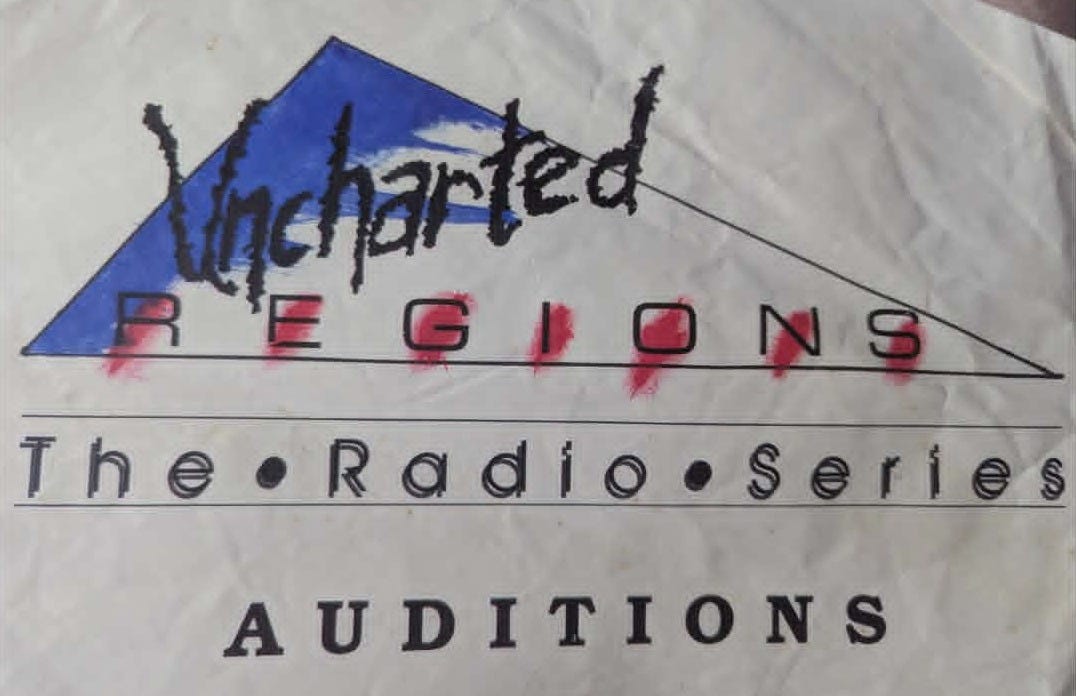
AT THE FIRST SIGN OF TROUBLE - I’ve still got one of the signs that we posted on the door to our audition rooms, sporting our original punky logo (translation, ugly). Ahhh, the triangle, the splotches of color. Last gasp of the 80s. But you gotta love that early Mac Eurostile + Avant Garde font.
#radiodrama #podcasting #scifi #fantasy #mystery #KTOW #UnchartedRegions #SandSprings #Tulsa #Oklahoma #RadioHistory